Dragon STEM · Read it in the book
Play the gameYour game is still open. Switch to its tab.

A fair test
A fair test changes only one thing. Everything else stays the same. Then we know what made the difference.
Word: Variable: something that can change in a test.
Read the words
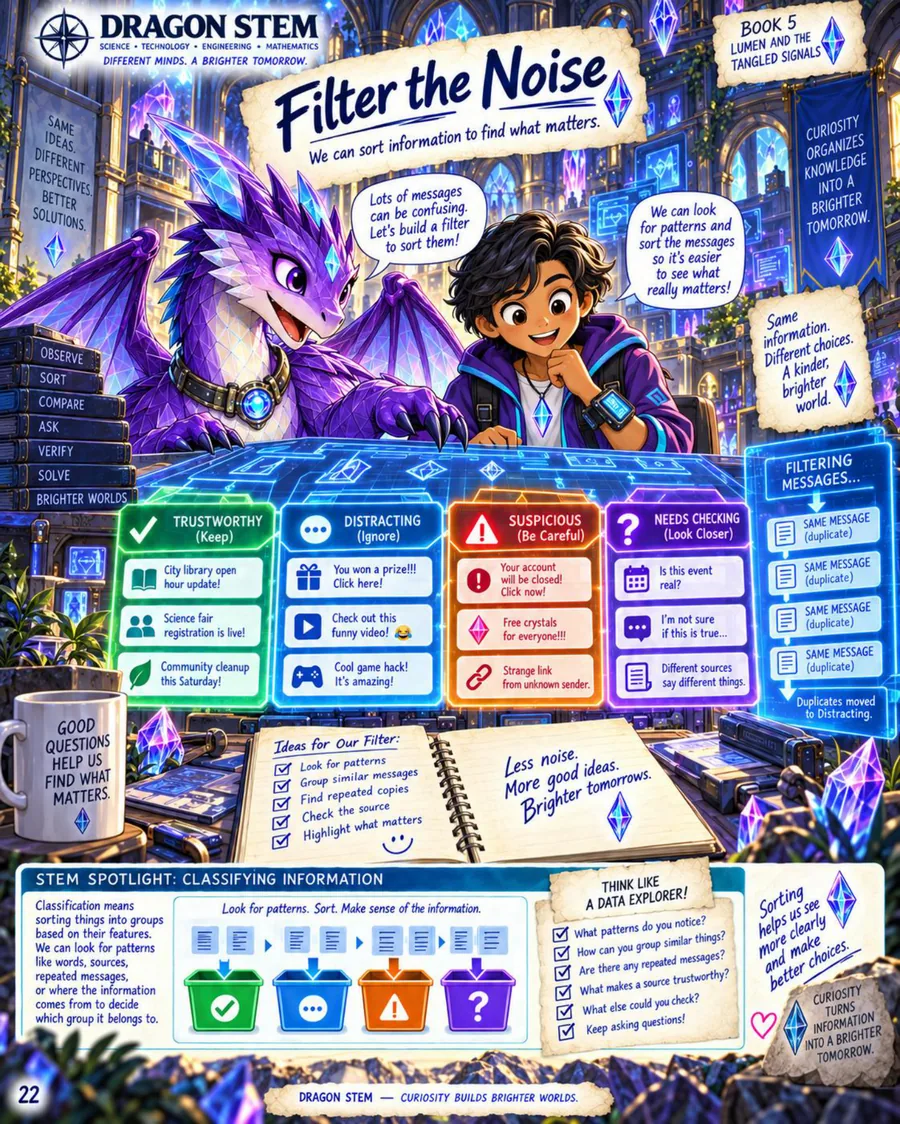
We can sort information to find what matters.
"Lots of messages can be confusing. Let's build a filter to sort them!"
"We can look for patterns and sort the messages so it's easier to see what really matters!"
Trustworthy (Keep): City library open hour update! Science fair registration is live! Community cleanup this Saturday!
Distracting (Ignore): You won a prize!!! Click here! Check out this funny video! Cool game hack! It's amazing!
Suspicious (Be Careful): Your account will be closed! Click now! Free crystals for everyone!!! Strange link from unknown sender.
Needs Checking (Look Closer): Is this event real? I'm not sure if this is true... Different sources say different things.
Filtering Messages... Same Message (duplicate) x4. Duplicates moved to Distracting.
Ideas for Our Filter: Look for patterns. Group similar messages. Find repeated copies. Check the source. Highlight what matters.
Less noise. More good ideas. Brighter tomorrows.
STEM Spotlight: Classifying Information — Classification means sorting things into groups based on their features. We can look for patterns like words, sources, repeated messages, or where the information comes from to decide which group it belongs to. Look for patterns. Sort. Make sense of the information.
Think Like a Data Explorer! What patterns do you notice? How can you group similar things? Are there any repeated messages? What makes a source trustworthy? What else could you check? Keep asking questions!
Sorting helps us see more clearly and make better choices.
Read the words
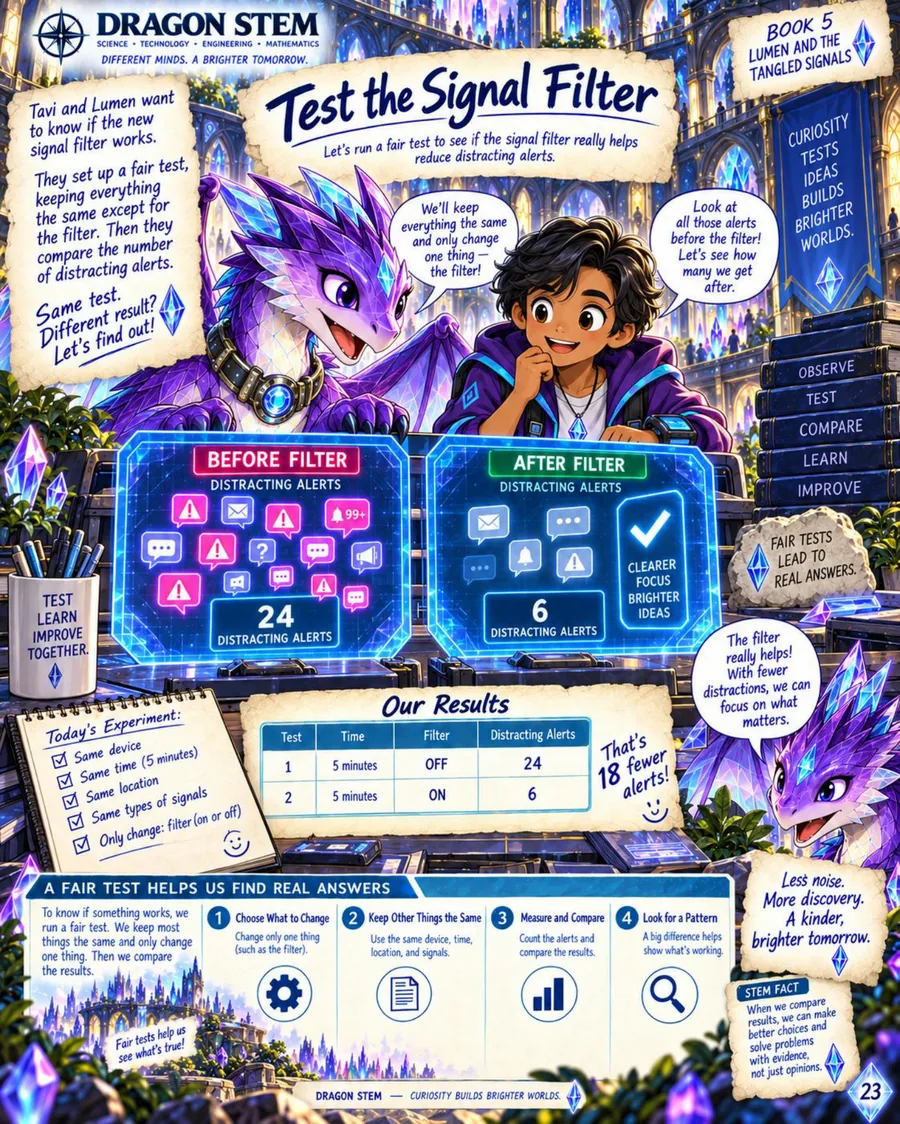
Tavi and Lumen want to know if the new signal filter works.
They set up a fair test, keeping everything the same except for the filter. Then they compare the number of distracting alerts.
Same test. Different result? Let's find out!
"We'll keep everything the same and only change one thing — the filter!" "Look at all those alerts before the filter! Let's see how many we get after."
Before Filter, Distracting Alerts: 24 distracting alerts.
After Filter, Distracting Alerts: 6 distracting alerts. Clearer focus, brighter ideas.
Today's Experiment: Same device. Same time (5 minutes). Same location. Same types of signals. Only change: filter (on or off).
Our Results — Test 1: Time 5 minutes, Filter OFF, Distracting Alerts 24. Test 2: Time 5 minutes, Filter ON, Distracting Alerts 6. That's 18 fewer alerts!
"The filter really helps! With fewer distractions, we can focus on what matters."
A Fair Test Helps Us Find Real Answers: To know if something works, we run a fair test. We keep most things the same and only change one thing. Then we compare the results.
1 Choose What to Change: Change only one thing (such as the filter). 2 Keep Other Things the Same: Use the same device, time, location, and signals. 3 Measure and Compare: Count the alerts and compare the results. 4 Look for a Pattern: A big difference helps show what's working.
Less noise. More discovery. A kinder, brighter tomorrow.
STEM FACT: When we compare results, we can make better choices and solve problems with evidence, not just opinions.
Read the words
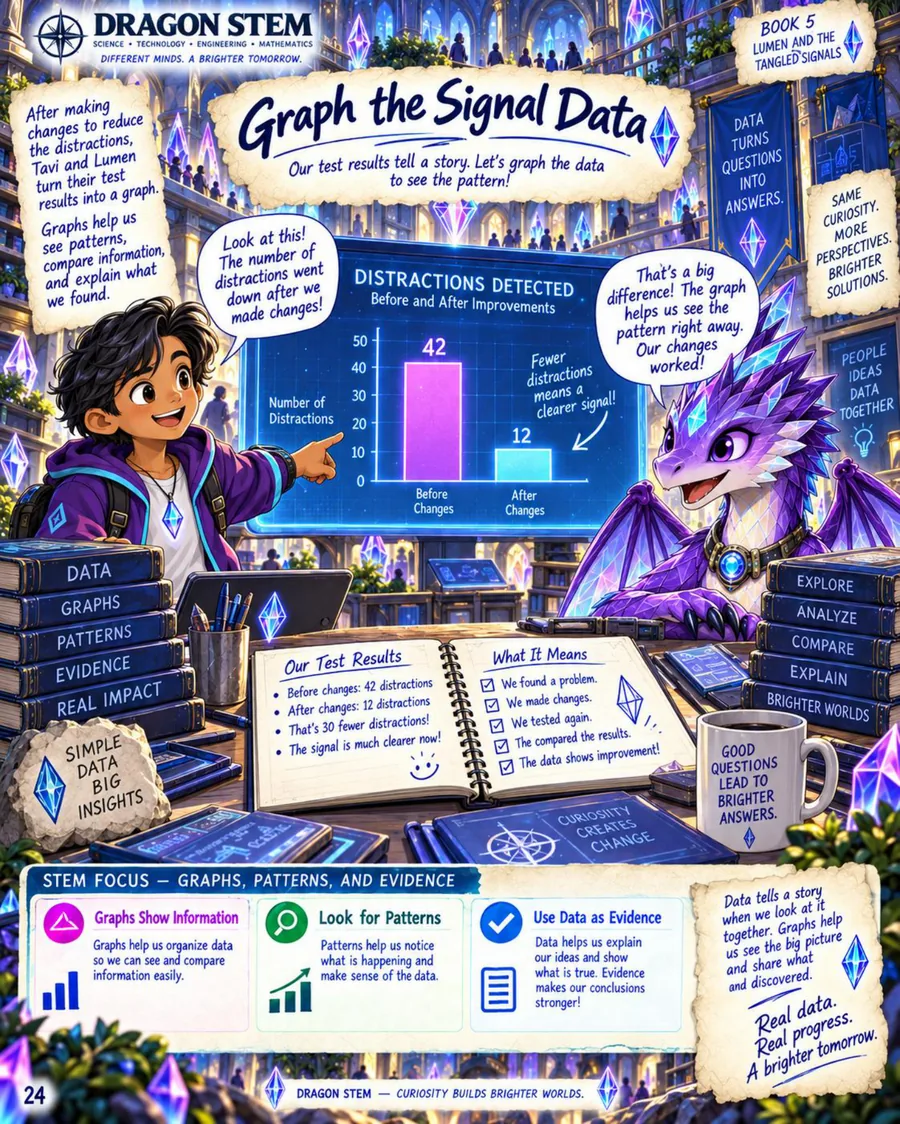
After making changes to reduce the distractions, Tavi and Lumen turn their test results into a graph.
Graphs help us see patterns, compare information, and explain what we found.
"Look at this! The number of distractions went down after we made changes!"
Distractions Detected, Before and After Improvements — Number of Distractions: Before Changes 42, After Changes 12. Fewer distractions means a clearer signal!
"That's a big difference! The graph helps us see the pattern right away. Our changes worked!"
Our Test Results: Before changes: 42 distractions. After changes: 12 distractions. That's 30 fewer distractions! The signal is much clearer now!
What It Means: We found a problem. We made changes. We tested again. The compared the results. The data shows improvement!
STEM Focus — Graphs, Patterns, and Evidence: Graphs Show Information — Graphs help us organize data so we can see and compare information easily. Look for Patterns — Patterns help us notice what is happening and make sense of the data. Use Data as Evidence — Data helps us explain our ideas and show what is true. Evidence makes our conclusions stronger!
Data tells a story when we look at it together. Graphs help us see the big picture and share what we discovered.
Real data. Real progress. A brighter tomorrow.
- Fold 2 paper planes the same way.
- Put a paper clip on the nose of 1 plane.
- Throw each 1 three times, the same way. Which flies farther?
You need: 2 sheets of paper, 1 paper clip.
Throw them where no one is standing.
Can you remember? Tavi changed the filter and moved to a quiet room. Is that test fair?
No. Two things changed, so we can't tell which one helped.
For grown-ups
Learning goal: I can plan a fair test, find how many fewer alerts the filter allowed, and explain why a test that changes 2 things is not fair.
Grade 3-5.
| Code | Standard |
|---|---|
| CSTA 1B-DA-07 | Use data to highlight or propose cause-and-effect relationships, predict outcomes, or communicate an idea. |
| 3-5-ETS1-3 | Plan and carry out fair tests in which variables are controlled and failure points are considered to identify aspects of a model or prototype that can be improved. |
| 3.MD.B.3 | Draw a scaled picture graph and a scaled bar graph to represent a data set with several categories. Solve one- and two-step "how many more" and "how many less" problems using information presented in scaled bar graphs. |
Talk about it:
- What is something else you could test by changing just one thing?
- Why is changing two things at once confusing for a test?
About 7 minutes.
How the game teaches it: evidence first, then the rider's hints (never the answer); no stars, scores or timers.
The full teacher guide is in the book.
Only the pages from this mission are shown here. From the Dragon STEM series by Adisak Sukul.