Dragon STEM · Read it in the book
Play the gameYour game is still open. Switch to its tab.

Check the source
Before you believe a message, ask where it came from. Tavi checks who sent a message and if it makes sense. A message from a stranger about a prize is a warning sign.
Word: Source: where information first comes from.
Read the words
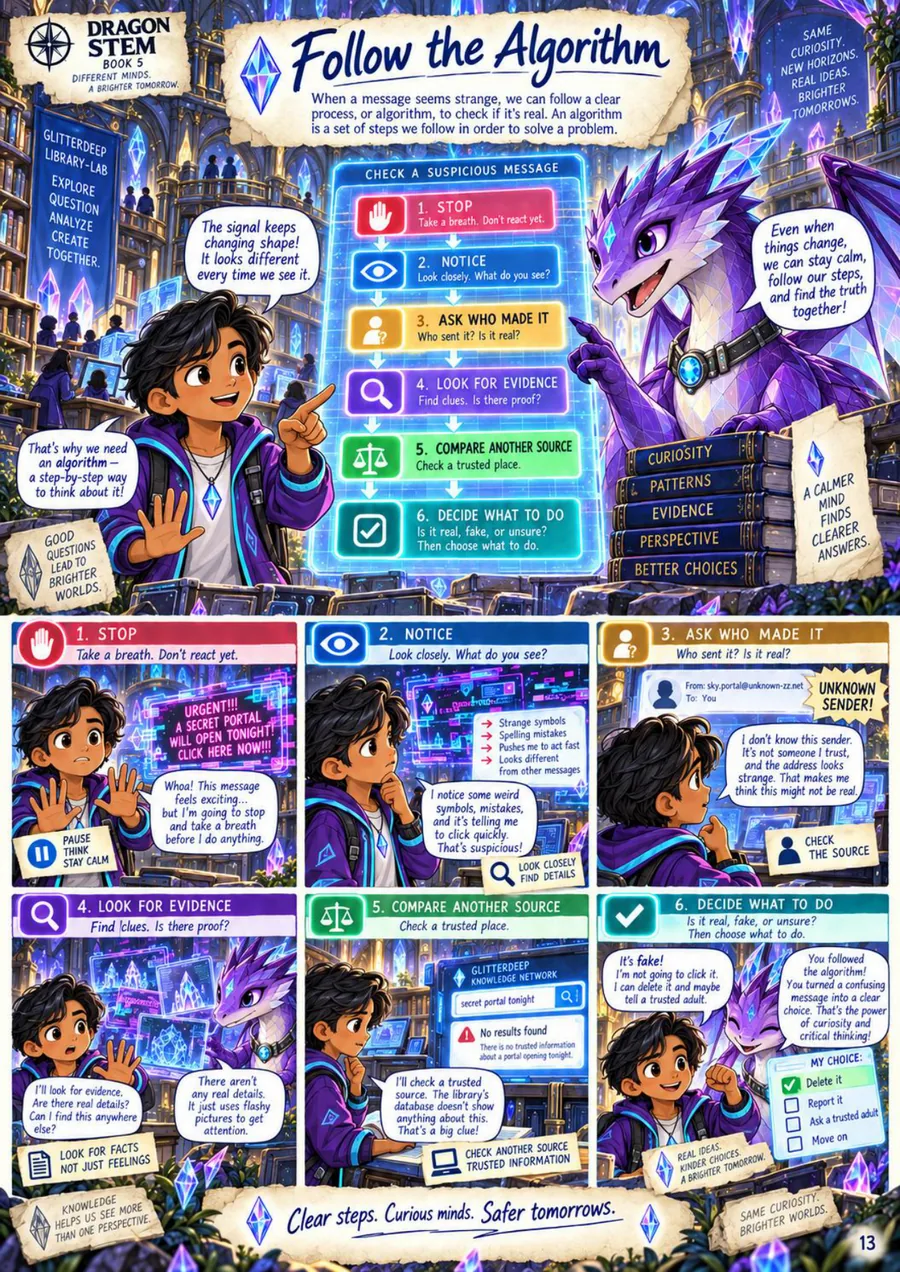
When a message seems strange, we can follow a clear process, or algorithm, to check if it's real. An algorithm is a set of steps we follow in order to solve a problem.
"The signal keeps changing shape! It looks different every time we see it."
"That's why we need an algorithm — a step-by-step way to think about it!"
Lumen: "Even when things change, we can stay calm, follow our steps, and find the truth together!"
Check a Suspicious Message — 1 Stop: Take a breath. Don't react yet. 2 Notice: Look closely. What do you see? 3 Ask Who Made It: Who sent it? Is it real? 4 Look for Evidence: Find clues. Is there proof? 5 Compare Another Source: Check a trusted place. 6 Decide What to Do: Is it real, fake, or unsure? Then choose what to do.
1 Stop: "URGENT!!! A SECRET PORTAL WILL OPEN TONIGHT! CLICK HERE NOW!!!" "Whoa! This message feels exciting... but I'm going to stop and take a breath before I do anything."
2 Notice: Strange symbols. Spelling mistakes. Pushes me to act fast. Looks different from other messages. "I notice some weird symbols, mistakes, and it's telling me to click quickly. That's suspicious!"
3 Ask Who Made It: From: sky.portal@unknown-zz.net. To: You. Unknown sender! "I don't know this sender. It's not someone I trust, and the address looks strange. That makes me think this might not be real."
4 Look for Evidence: "I'll look for evidence. Are there real details? Can I find this anywhere else?" "There aren't any details. It just uses flashy pictures to get attention."
5 Compare Another Source: Glitterdeep Knowledge Network — "secret portal tonight" — No results found. There is no trusted information about a portal opening tonight. "I'll check a trusted source. The library's database doesn't show anything about this. That's a big clue!"
6 Decide What to Do: "It's fake! I'm not going to click it. I can delete it and maybe tell a trusted adult." My Choice: Delete it. Report it. Ask a trusted adult. Move on. "You followed the algorithm! You turned a confusing message into a clear choice. That's the power of curiosity and critical thinking!"
Clear steps. Curious minds. Safer tomorrows.
Read the words
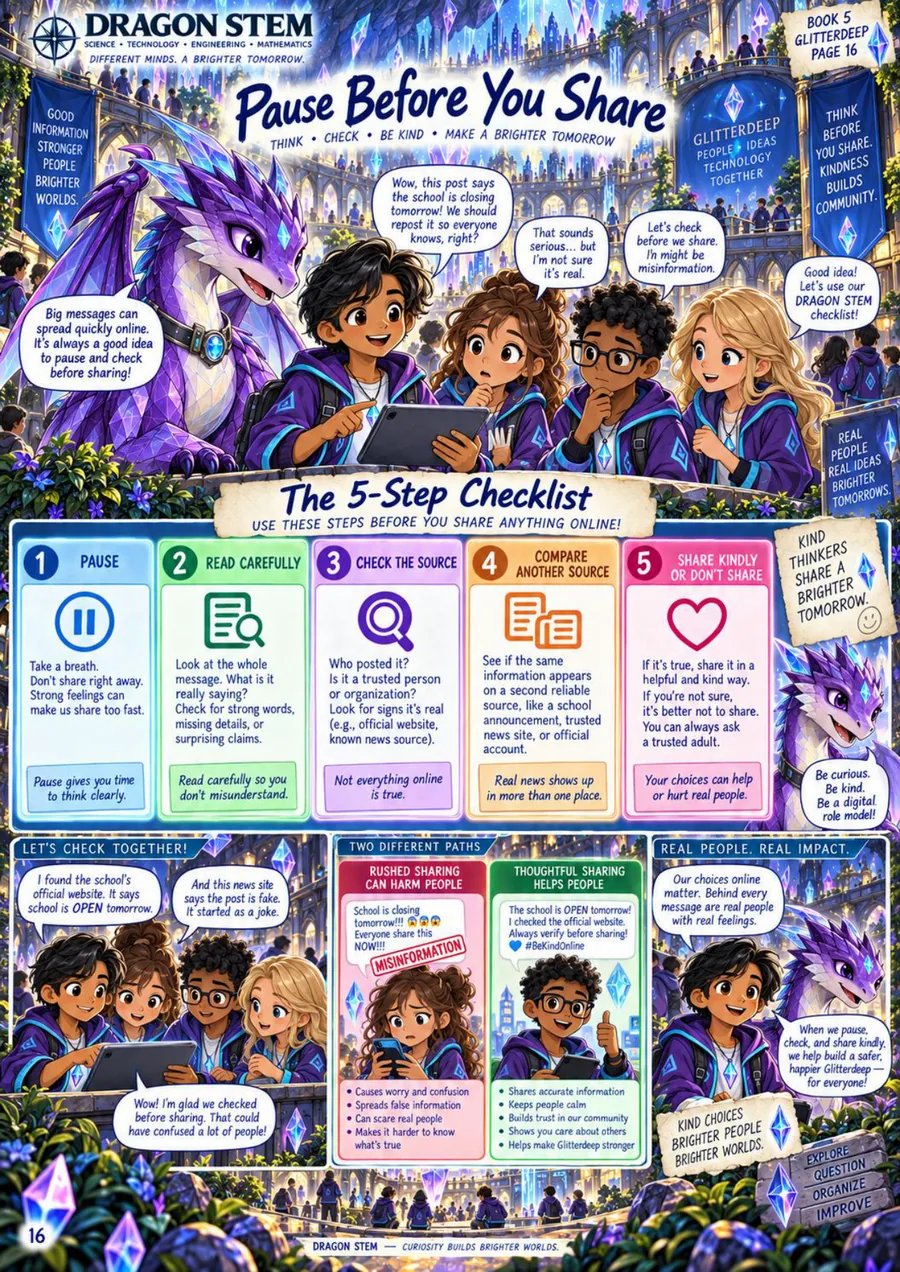
Think. Check. Be kind. Make a brighter tomorrow.
"Wow, this post says the school is closing tomorrow! We should repost it so everyone knows, right?"
"That sounds serious... but I'm not sure it's real."
"Let's check before we share. I'n might be misinformation."
"Good idea! Let's use our Dragon STEM checklist!"
Big messages can spread quickly online. It's always a good idea to pause and check before sharing.
The 5-Step Checklist, use these steps before you share anything online! 1 Pause: Take a breath. Don't share right away. Strong feelings can make us share too fast. Pause gives you time to think clearly.
2 Read Carefully: Look at the whole message. What is it really saying? Check for strong words, missing details, or surprising claims. Read carefully so you don't misunderstand.
3 Check the Source: Who posted it? Is it a trusted person or organization? Look for signs it's real (e.g., official website, known news source). Not everything online is true.
4 Compare Another Source: See if the same information appears on a second reliable source, like a school announcement, trusted news site, or official account. Real news shows up in more than one place.
5 Share Kindly or Don't Share: If it's true, share it in a helpful and kind way. If you're not sure, it's better not to share. You can always ask a trusted adult. Your choices can help or hurt real people.
Let's Check Together! "I found the school's official website. It says school is OPEN tomorrow." "And this news site says the post is fake. It started as a joke." "Wow! I'm glad we checked before sharing. That could have confused a lot of people!"
Two Different Paths — Rushed Sharing Can Harm People: "School is closing tomorrow!!! Everyone share this NOW!!!" Misinformation. Causes worry and confusion. Spreads false information. Can scare real people. Makes it harder to know what's true.
Thoughtful Sharing Helps People: "The school is OPEN tomorrow! I checked the official website. Always verify before sharing! #BeKindOnline" Shares accurate information. Keeps people calm. Builds trust in our community. Shows you care about others. Helps make Glitterdeep stronger.
Real People. Real Impact. "Our choices online matter. Behind every message are real people with real feelings." "When we pause, check, and share kindly, we help build a safer, happier Glitterdeep — for everyone!"
Read the words
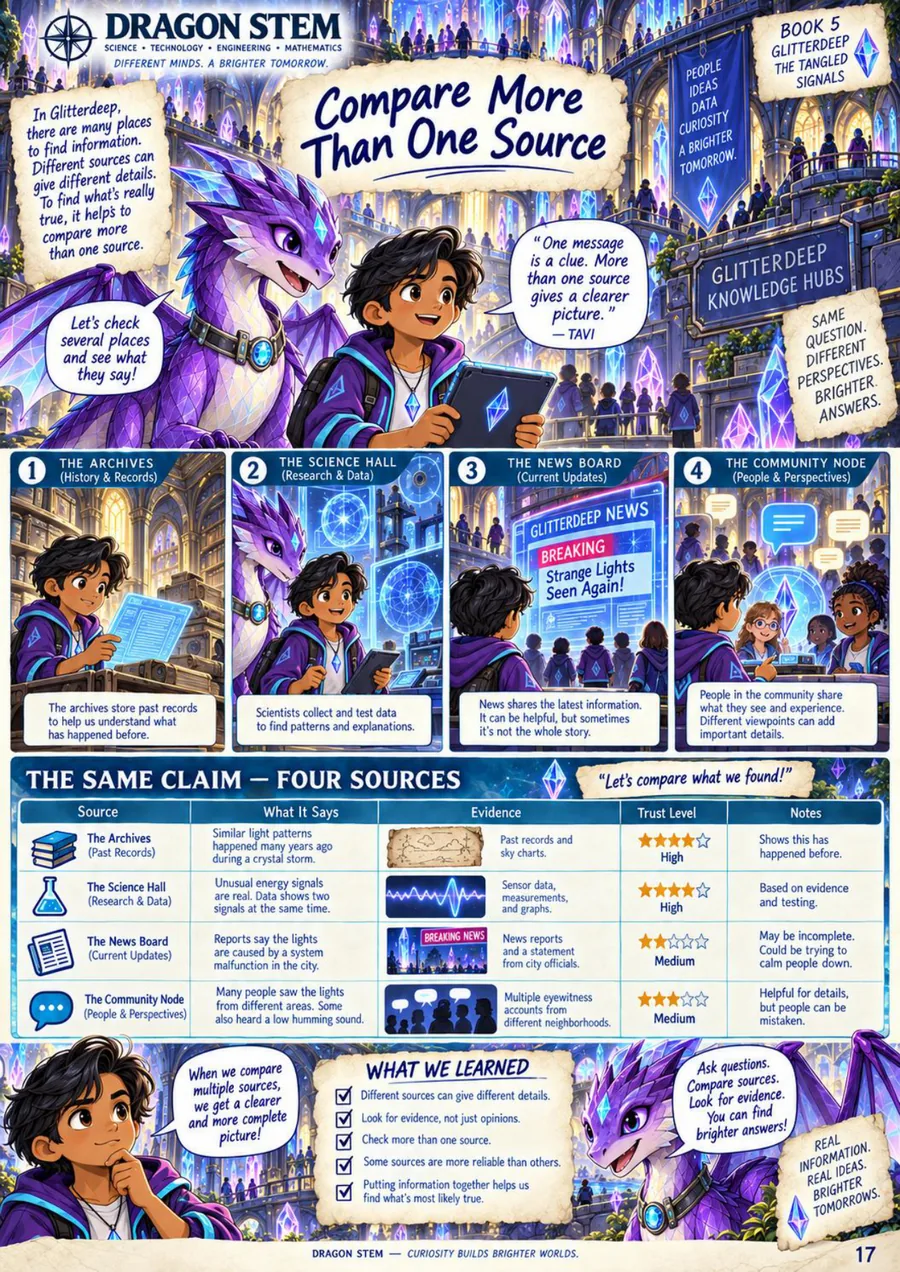
In Glitterdeep, there are many places to find information. Different sources can give different details. To find what's really true, it helps to compare more than one source.
"Let's check several places and see what they say!"
Tavi: "One message is a clue. More than one source gives a clearer picture."
1 The Archives (History & Records): The archives store past records to help us understand what has happened before.
2 The Science Hall (Research & Data): Scientists collect and test data to find patterns and explanations.
3 The News Board (Current Updates): GLITTERDEEP NEWS — BREAKING: Strange Lights Seen Again! News shares the latest information. It can be helpful, but sometimes it's not the whole story.
4 The Community Node (People & Perspectives): People in the community share what they see and experience. Different viewpoints can add important details.
The Same Claim — Four Sources: "Let's compare what we found!"
The Archives (Past Records): Similar light patterns happened many years ago during a crystal storm. Evidence: Past records and sky charts. Trust Level: High. Notes: Shows this has happened before.
The Science Hall (Research & Data): Unusual energy signals are real. Data shows two signals at the same time. Evidence: Sensor data, measurements, and graphs. Trust Level: High. Notes: Based on evidence and testing.
The News Board (Current Updates): Reports say the lights are caused by a system malfunction in the city. Evidence: News reports and a statement from city officials. Trust Level: Medium. Notes: May be incomplete. Could be trying to calm people down.
The Community Node (People & Perspectives): Many people saw the lights from different areas. Some also heard a low humming sound. Evidence: Multiple eyewitness accounts from different neighborhoods. Trust Level: Medium. Notes: Helpful for details, but people can be mistaken.
"When we compare multiple sources, we get a clearer and more complete picture!"
What We Learned: Different sources can give different details. Look for evidence, not just opinions. Check more than one source. Some sources are more reliable than others. Putting information together helps us find what's most likely true.
Ask questions. Compare sources. Look for evidence. You can find brighter answers!
Read the words
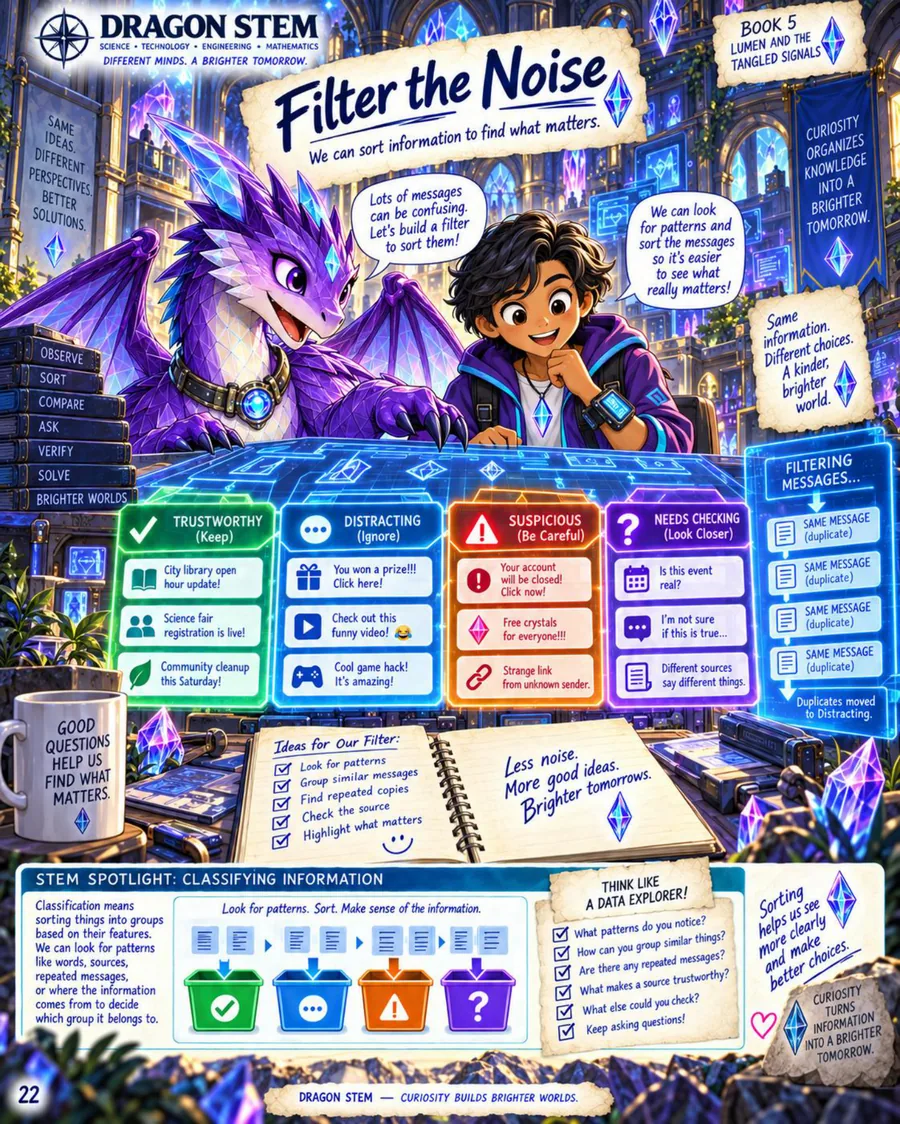
We can sort information to find what matters.
"Lots of messages can be confusing. Let's build a filter to sort them!"
"We can look for patterns and sort the messages so it's easier to see what really matters!"
Trustworthy (Keep): City library open hour update! Science fair registration is live! Community cleanup this Saturday!
Distracting (Ignore): You won a prize!!! Click here! Check out this funny video! Cool game hack! It's amazing!
Suspicious (Be Careful): Your account will be closed! Click now! Free crystals for everyone!!! Strange link from unknown sender.
Needs Checking (Look Closer): Is this event real? I'm not sure if this is true... Different sources say different things.
Filtering Messages... Same Message (duplicate) x4. Duplicates moved to Distracting.
Ideas for Our Filter: Look for patterns. Group similar messages. Find repeated copies. Check the source. Highlight what matters.
Less noise. More good ideas. Brighter tomorrows.
STEM Spotlight: Classifying Information — Classification means sorting things into groups based on their features. We can look for patterns like words, sources, repeated messages, or where the information comes from to decide which group it belongs to. Look for patterns. Sort. Make sense of the information.
Think Like a Data Explorer! What patterns do you notice? How can you group similar things? Are there any repeated messages? What makes a source trustworthy? What else could you check? Keep asking questions!
Sorting helps us see more clearly and make better choices.
- Find an old message, letter or email with a grown-up.
- Look for who sent it and when.
- Ask: does the sender make sense for this message?
- Talk about it with a grown-up.
You need: an old message, letter or email.
Ask a grown-up first. Never reply to a message alone.
Can you remember? A message says you won a prize you never entered. What should you check first?
Where it came from. If you don't know the sender, don't click. Tell a grown-up.
For grown-ups
Learning goal: I can follow a checking algorithm to decide if a message is real, choose a safe action, and sort messages by how trustworthy they are.
Grade 3-5.
| Code | Standard |
|---|---|
| ISTE-S 3b | Students evaluate the accuracy, perspective, credibility and relevance of information, media, data or other resources. |
| CSTA 1B-NI-05 | Discuss real-world cybersecurity problems and how personal information can be protected. |
Talk about it:
- What would you look for to check if a message is real?
- Why tell a trusted adult about a suspicious message?
About 8 minutes.
How the game teaches it: evidence first, then the rider's hints (never the answer); no stars, scores or timers.
The full teacher guide is in the book.
Only the pages from this mission are shown here. From the Dragon STEM series by Adisak Sukul.