Dragon STEM · Read it in the book
Play the gameYour game is still open. Switch to its tab.

Find the source
A problem often starts at one source. Litter was jammed at the tide gate, not made there. Clearing the real source helps the whole area.
Word: Source: the place something comes from.
Read the words
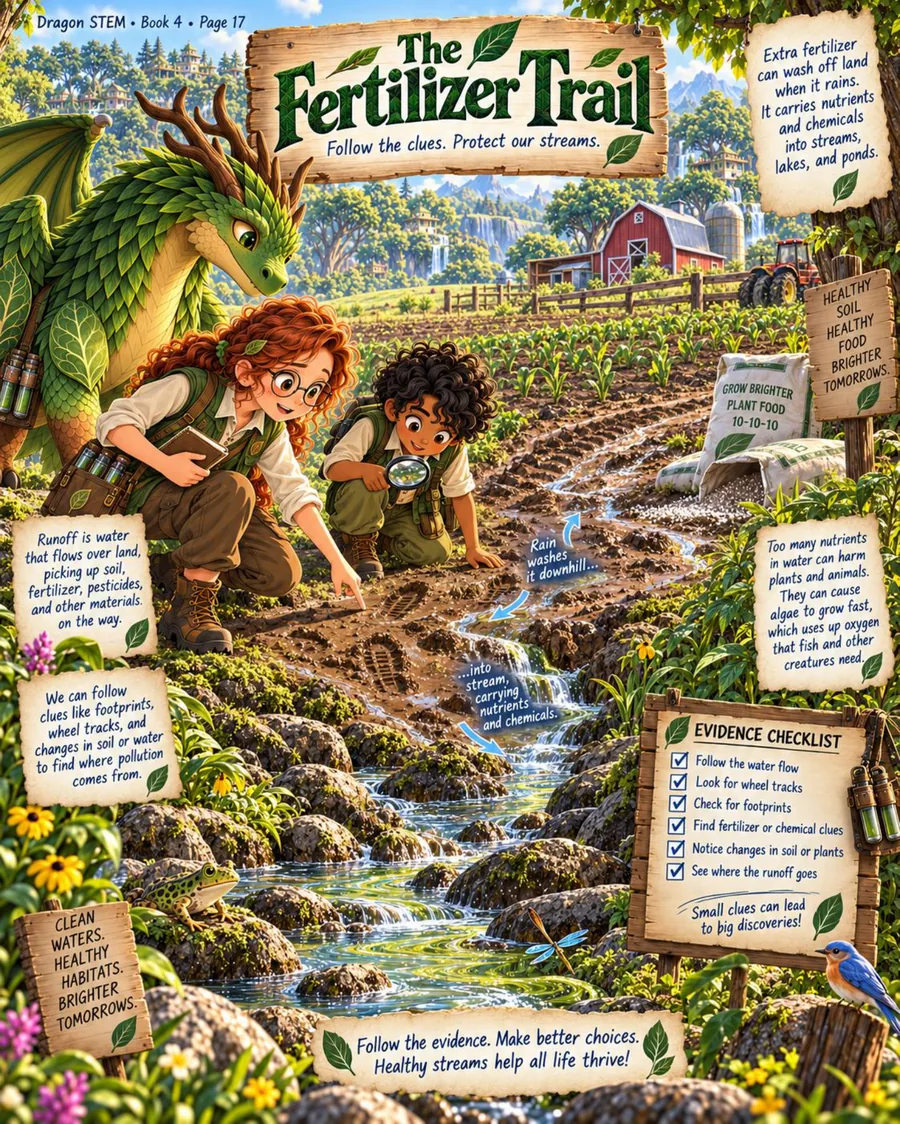
Follow the clues. Protect our streams.
Runoff is water that flows over land, picking up soil, fertilizer, pesticides, and other materials on the way.
We can follow clues like footprints, wheel tracks, and changes in soil or water to find where pollution comes from.
Grow Brighter Plant Food, 10-10-10.
Rain washes it downhill... into stream, carrying nutrients and chemicals.
Extra fertilizer can wash off land when it rains. It carries nutrients and chemicals into streams, lakes, and ponds.
Too many nutrients in water can harm plants and animals. They can cause algae to grow fast, which uses up oxygen that fish and other creatures need.
Evidence Checklist: Follow the water flow. Look for wheel tracks. Check for footprints. Find fertilizer or chemical clues. Notice changes in soil or plants. See where the runoff goes.
Small clues can lead to big discoveries!
Follow the evidence. Make better choices. Healthy streams help all life thrive!
Read the words
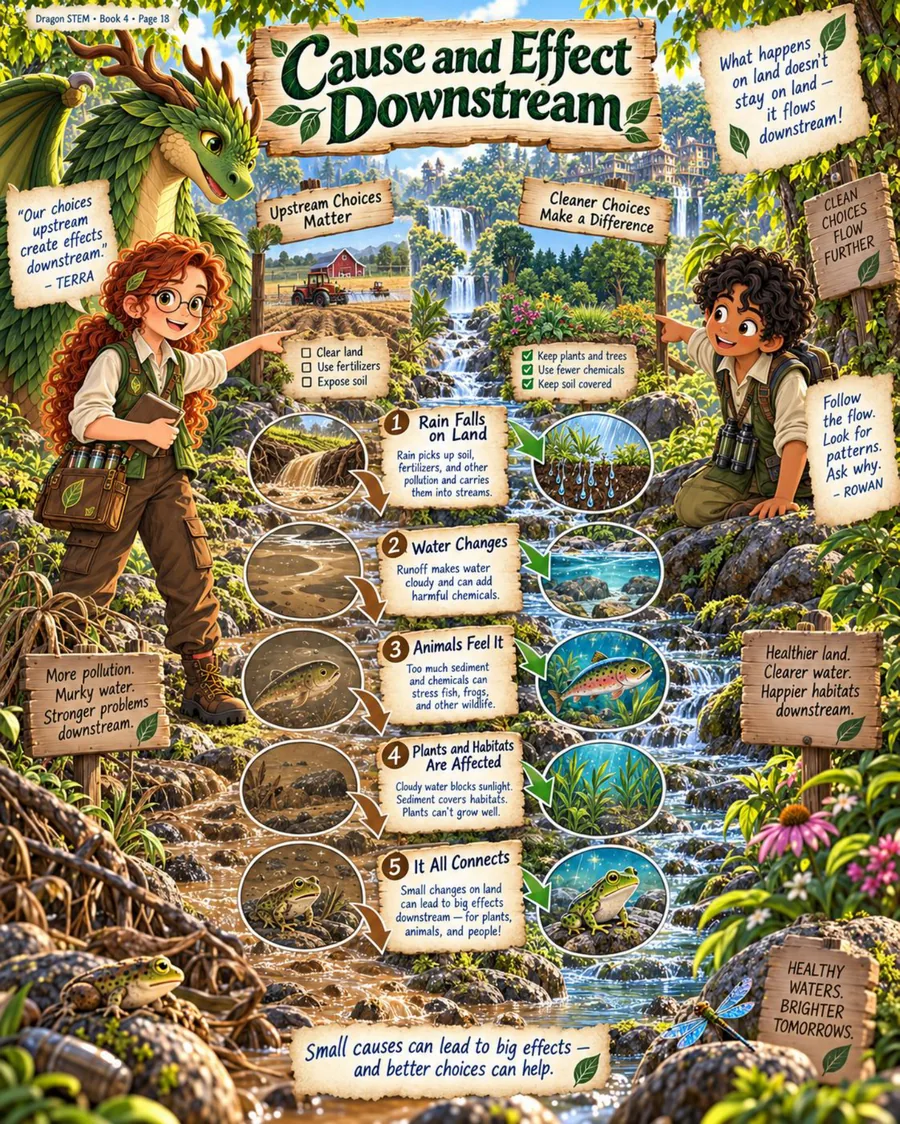
What happens on land doesn't stay on land — it flows downstream!
Terra: "Our choices upstream create effects downstream."
Rowan: "Follow the flow. Look for patterns. Ask why."
Upstream Choices Matter: Clear land. Use fertilizers. Expose soil.
Cleaner Choices Make a Difference: Keep plants and trees. Use fewer chemicals. Keep soil covered.
1 Rain Falls on Land: Rain picks up soil, fertilizers, and other pollution and carries them into streams.
2 Water Changes: Runoff makes water cloudy and can add harmful chemicals.
3 Animals Feel It: Too much sediment and chemicals can stress fish, frogs, and other wildlife.
4 Plants and Habitats Are Affected: Cloudy water blocks sunlight. Sediment covers habitats. Plants can't grow well.
5 It All Connects: Small changes on land can lead to big effects downstream — for plants, animals, and people!
Small causes can lead to big effects — and better choices can help.
More pollution. Murky water. Stronger problems downstream.
Clean choices flow further.
Healthier land. Clearer water. Happier habitats downstream.
Read the words
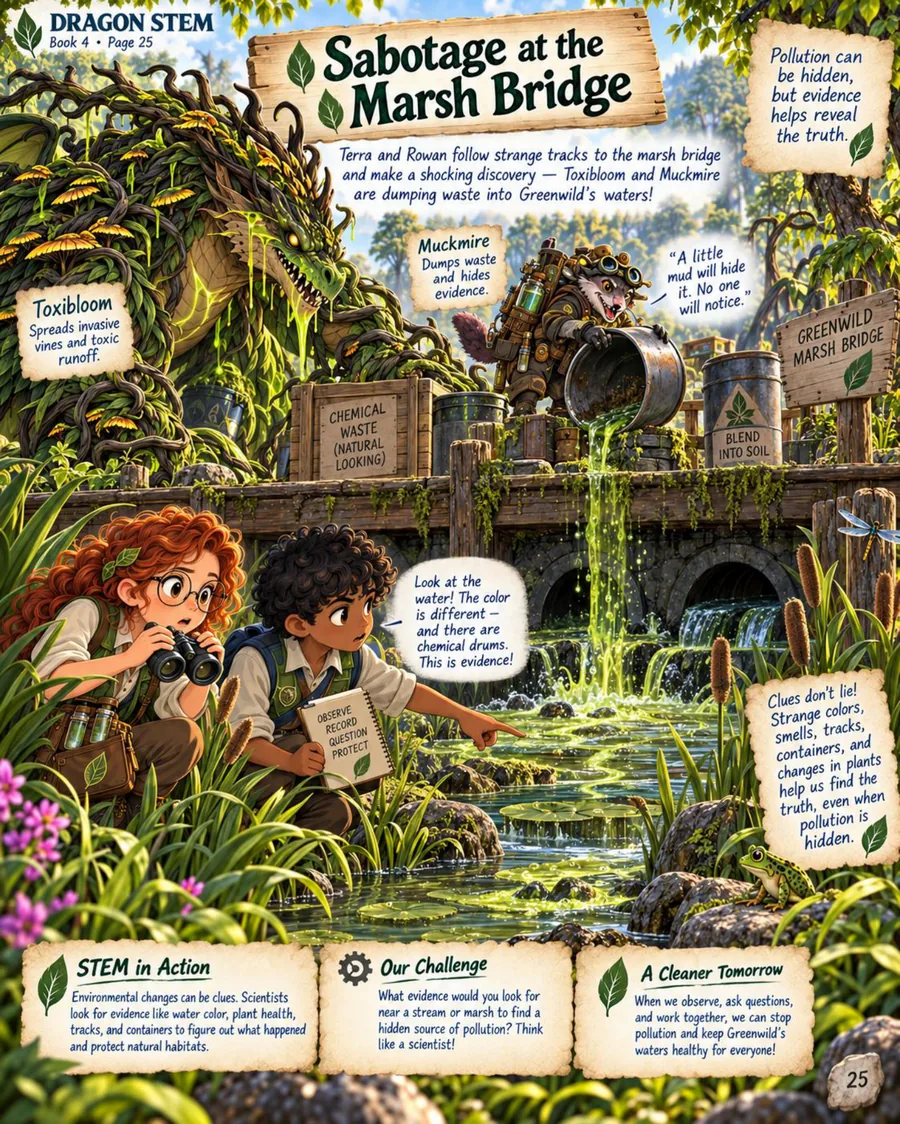
Terra and Rowan follow strange tracks to the marsh bridge and make a shocking discovery — Toxibloom and Muckmire are dumping waste into Greenwild's waters!
Toxibloom: Spreads invasive vines and toxic runoff.
Muckmire: Dumps waste and hides evidence.
Greenwild Marsh Bridge.
Chemical Waste (Natural Looking).
Blend Into Soil.
Muckmire: "A little mud will hide it. No one will notice."
Rowan: "Look at the water! The color is different — and there are chemical drums. This is evidence!"
Pollution can be hidden, but evidence helps reveal the truth.
Clues don't lie! Strange colors, smells, tracks, containers, and changes in plants help us find the truth, even when pollution is hidden.
STEM in Action: Environmental changes can be clues. Scientists look for evidence like water color, plant health, tracks, and containers to figure out what happened and protect natural habitats.
Our Challenge: What evidence would you look for near a stream or marsh to find a hidden source of pollution? Think like a scientist!
A Cleaner Tomorrow: When we observe, ask questions, and work together, we can stop pollution and keep Greenwild's waters healthy for everyone!
Read the words
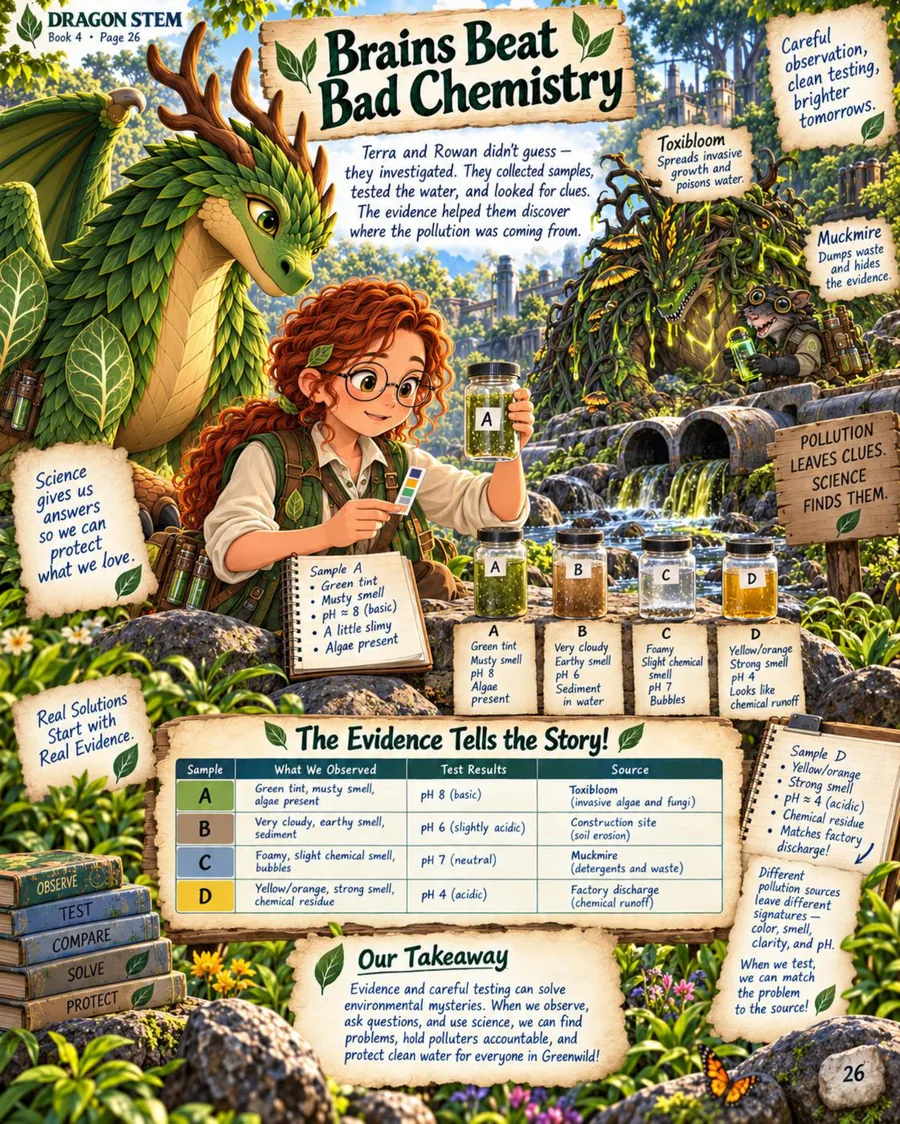
Terra and Rowan didn't guess — they investigated.
They collected samples, tested the water, and looked for clues.
The evidence helped them discover where the pollution was coming from.
Toxibloom: Spreads invasive growth and poisons water.
Muckmire: Dumps waste and hides the evidence.
Science gives us answers so we can protect what we love.
Real Solutions Start with Real Evidence.
Pollution leaves clues. Science finds them.
Sample A: Green tint, musty smell, pH ≈ 8 (basic), a little slimy, algae present.
Sample B: Very cloudy, earthy smell, pH 6, sediment in water.
Sample C: Foamy, slight chemical smell, pH 7, bubbles.
Sample D: Yellow/orange, strong smell, pH ≈ 4 (acidic), chemical residue, matches factory discharge.
The Evidence Tells the Story! — Sample A: Green tint, musty smell, algae present. Test Results: pH 8 (basic). Source: Toxibloom (invasive algae and fungi).
Sample B: Very cloudy, earthy smell, sediment. Test Results: pH 6 (slightly acidic). Source: Construction site (soil erosion).
Sample C: Foamy, slight chemical smell, bubbles. Test Results: pH 7 (neutral). Source: Muckmire (detergents and waste).
Sample D: Yellow/orange, strong smell, chemical residue. Test Results: pH 4 (acidic). Source: Factory discharge (chemical runoff).
Different pollution sources leave different signatures — color, smell, clarity, and pH. When we test, we can match the problem to the source!
Our Takeaway: Evidence and careful testing can solve environmental mysteries. When we observe, ask questions, and use science, we can find problems, hold polluters accountable, and protect clean water for everyone in Greenwild!
Real-world note. Never sniff a liquid you do not know. We test by looking instead.
For grown-ups
This page's detective table includes a smell column. Smelling an unknown liquid is not a safe classroom or at-home practice, so the game's own version of this test drops smell and uses only sight: color, cloudiness, and foam or sheen.
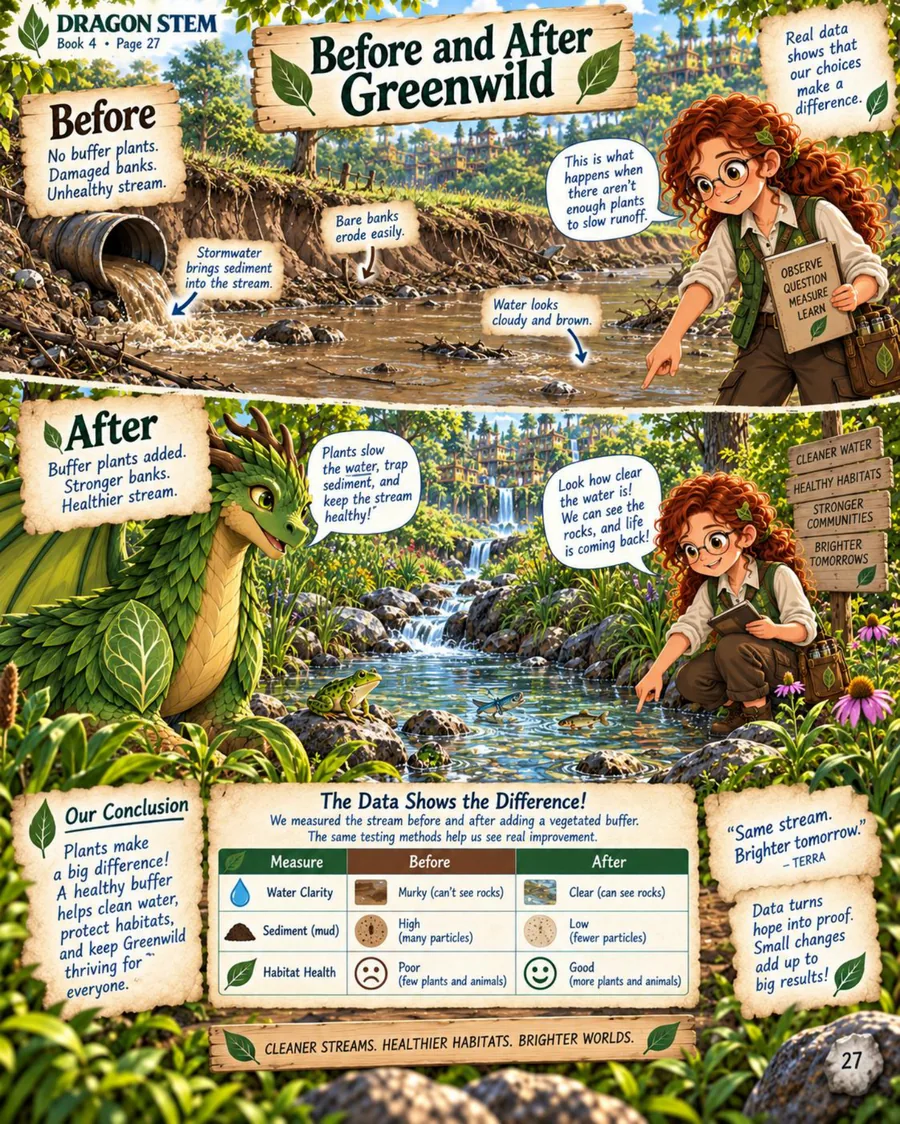
Read the words
Before: No buffer plants. Damaged banks. Unhealthy stream.
Stormwater brings sediment into the stream. Bare banks erode easily. Water looks cloudy and brown.
Terra: "This is what happens when there aren't enough plants to slow runoff."
After: Buffer plants added. Stronger banks. Healthier stream.
Terra: "Plants slow the water, trap sediment, and keep the stream healthy!"
Terra: "Look how clear the water is! We can see the rocks, and life is coming back!"
Our Conclusion: Plants make a big difference! A healthy buffer helps clean water, protect habitats, and keep Greenwild thriving for everyone.
The Data Shows the Difference! We measured the stream before and after adding a vegetated buffer. The same testing methods help us see real improvement.
Water Clarity: Before Murky (can't see rocks), After Clear (can see rocks).
Sediment (mud): Before High (many particles), After Low (fewer particles).
Habitat Health: Before Poor (few plants and animals), After Good (more plants and animals).
Terra: "Same stream. Brighter tomorrow."
Cleaner streams. Healthier habitats. Brighter worlds.
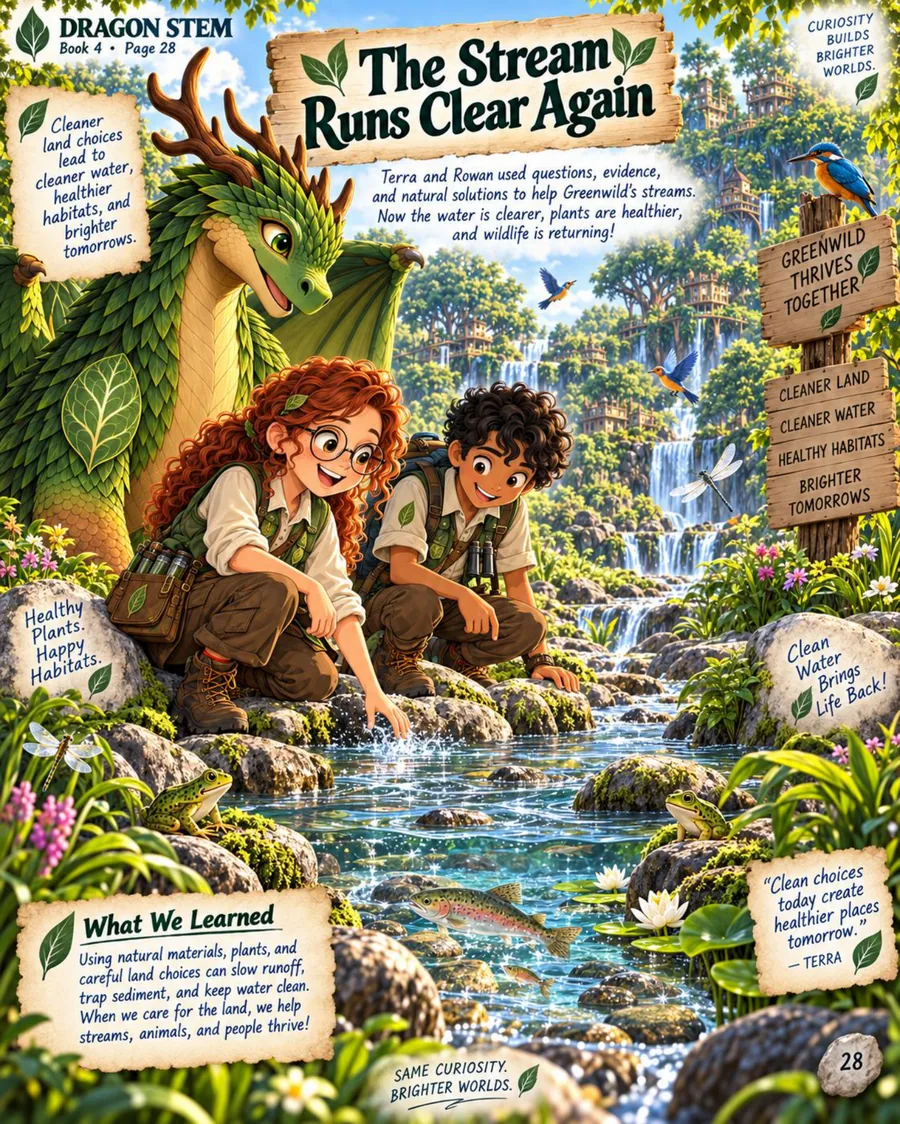
Read the words
Terra and Rowan used questions, evidence, and natural solutions to help Greenwild's streams.
Now the water is clearer, plants are healthier, and wildlife is returning!
Cleaner land choices lead to cleaner water, healthier habitats, and brighter tomorrows.
Healthy Plants. Happy Habitats.
Clean Water Brings Life Back!
What We Learned: Using natural materials, plants, and careful land choices can slow runoff, trap sediment, and keep water clean. When we care for the land, we help streams, animals, and people thrive!
Terra: "Clean choices today create healthier places tomorrow."
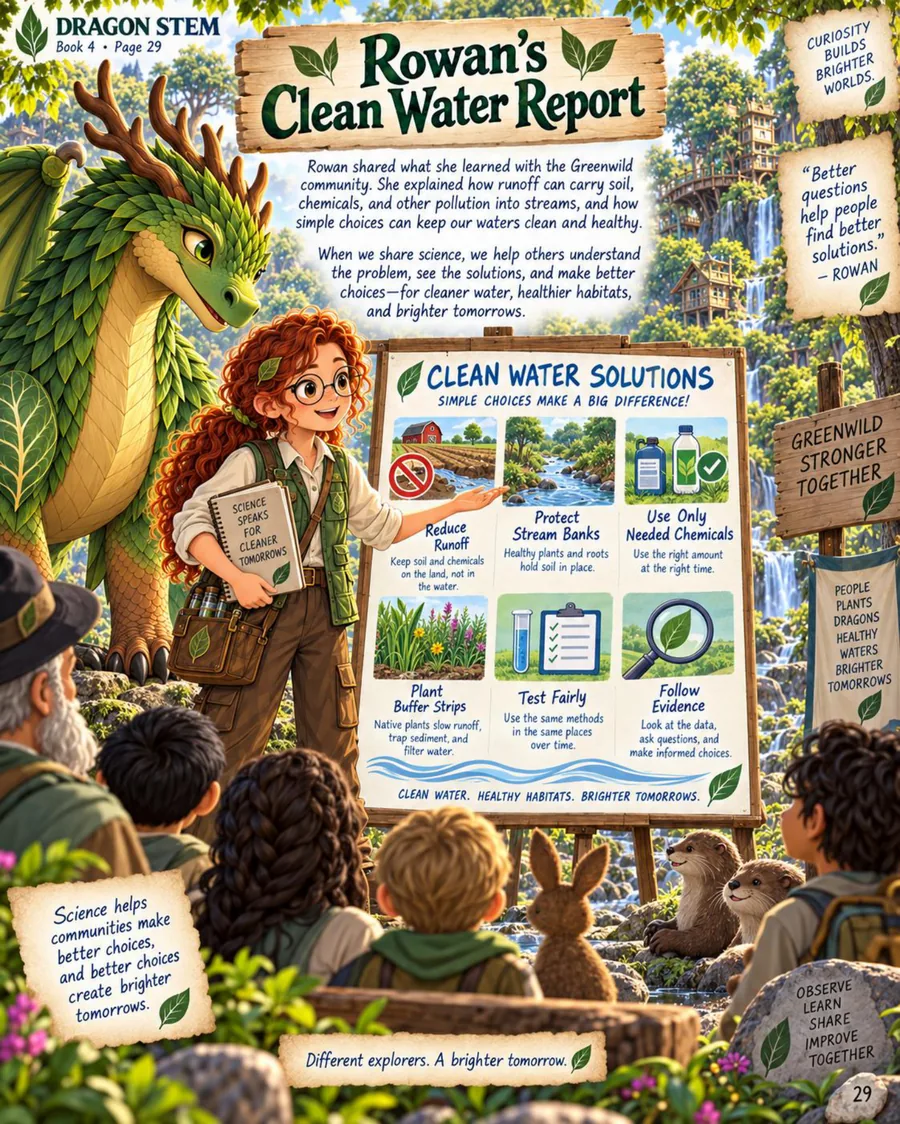
Read the words
Rowan shared what she learned with the Greenwild community.
She explained how runoff can carry soil, chemicals, and other pollution into streams, and how simple choices can keep our waters clean and healthy.
When we share science, we help others understand the problem, see the solutions, and make better choices — for cleaner water, healthier habitats, and brighter tomorrows.
Clean Water Solutions, simple choices make a big difference! Reduce Runoff: Keep soil and chemicals on the land, not in the water.
Protect Stream Banks: Healthy plants and roots hold soil in place.
Use Only Needed Chemicals: Use the right amount at the right time.
Plant Buffer Strips: Native plants slow runoff, trap sediment, and filter water.
Test Fairly: Use the same methods in the same places over time.
Follow Evidence: Look at the data, ask questions, and make informed choices.
Clean water. Healthy habitats. Brighter tomorrows.
Rowan: "Better questions help people find better solutions."
Science helps communities make better choices, and better choices create brighter tomorrows.
Different explorers. A brighter tomorrow.
- Find a trail of something at home, like crumbs or water drops.
- Follow the trail to where it starts.
- That starting point is the source.
You need: none, just your eyes.
Can you remember? Bubbles keep floating up in one spot of a pond. Where should you look first?
Right under that spot, for whatever is making the bubbles.
For grown-ups
Learning goal: I can use samples above and below a bridge to find where pollution enters, and tell what we saw from what we think.
Grade 4-5.
| Code | Standard |
|---|---|
| 5-ESS3-1 | Obtain and combine information about ways individual communities use science ideas to protect the Earth's resources and environment. |
| 5-PS1-1 | Develop a model to describe that matter is made of particles too small to be seen. |
| 5-LS2-1 | Develop a model to describe the movement of matter among plants, animals, decomposers, and the environment. |
Talk about it:
- Ask your child how they would prove where a problem started, using only what they can observe.
- Discuss why something can still be a problem even after it becomes invisible, like salt dissolved in water.
About 10 minutes.
How the game teaches it: evidence first, then the rider's hints (never the answer); no stars, scores or timers.
The full teacher guide is in the book.
Only the pages from this mission are shown here. From the Dragon STEM series by Adisak Sukul.