Dragon STEM · Read it in the book
Play the gameYour game is still open. Switch to its tab.

A fair test
A fair test changes only one thing. Everything else stays the same. Then we know what made the difference.
Word: Variable: something that can change in a test.
Read the words
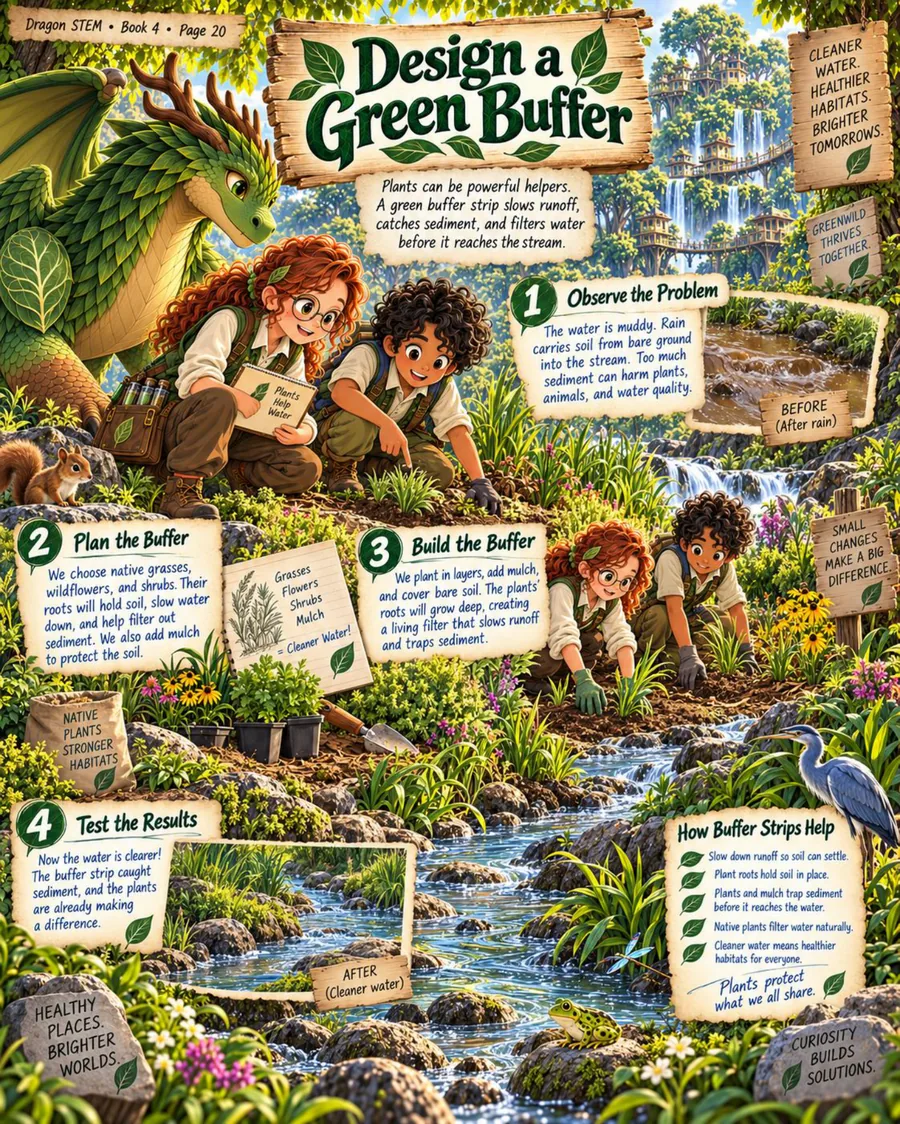
Plants can be powerful helpers.
A green buffer strip slows runoff, catches sediment, and filters water before it reaches the stream.
Grasses. Flowers. Shrubs. Mulch. = Cleaner Water!
1 Observe the Problem: The water is muddy. Rain carries soil from bare ground into the stream. Too much sediment can harm plants, animals, and water quality.
2 Plan the Buffer: We choose native grasses, wildflowers, and shrubs. Their roots will hold soil, slow water down, and help filter out sediment. We also add mulch to protect the soil.
3 Build the Buffer: We plant in layers, add mulch, and cover bare soil. The plants' roots will grow deep, creating a living filter that slows runoff and traps sediment.
4 Test the Results: Now the water is clearer! The buffer strip caught sediment, and the plants are already making a difference.
How Buffer Strips Help: Slow down runoff so soil can settle. Plant roots hold soil in place. Plants and mulch trap sediment before it reaches the water. Native plants filter water naturally. Cleaner water means healthier habitats for everyone.
Plants protect what we all share.
Before (After rain).
After (Cleaner water).
Read the words
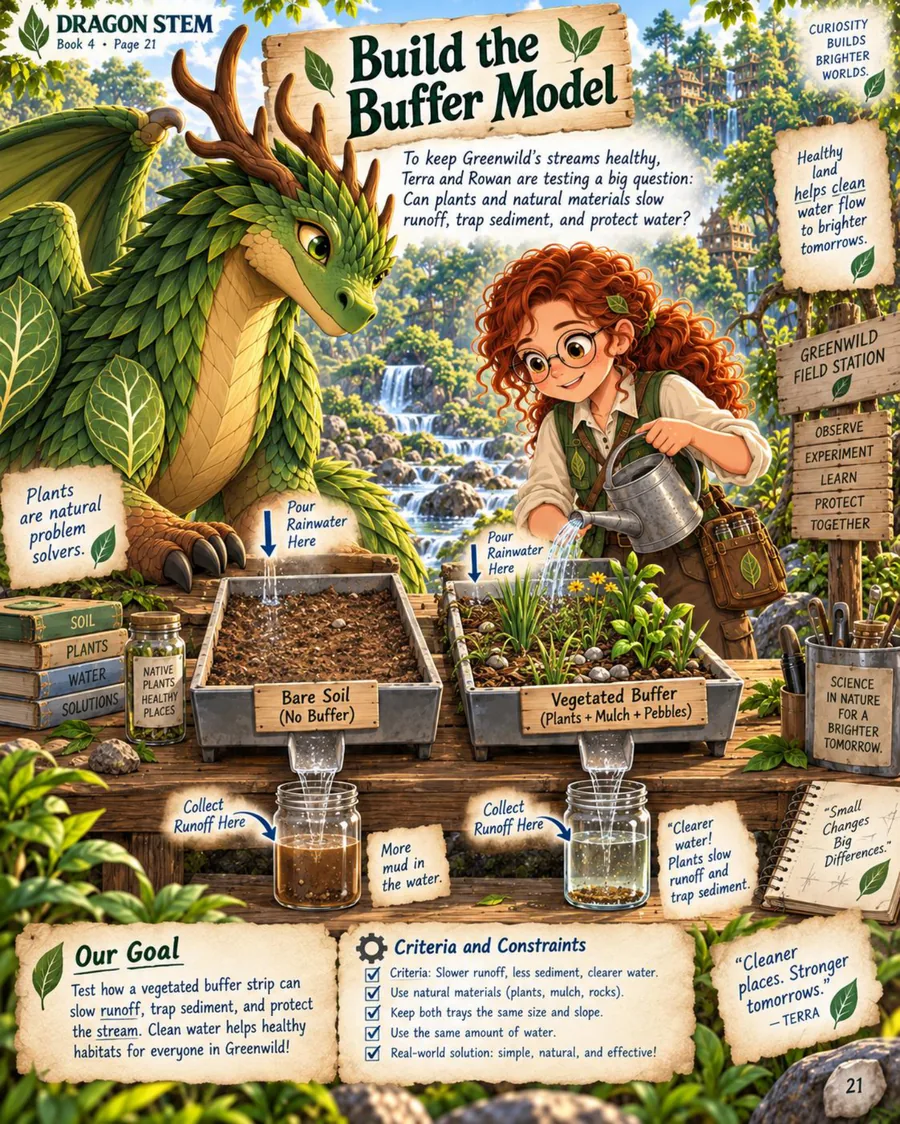
To keep Greenwild's streams healthy, Terra and Rowan are testing a big question: Can plants and natural materials slow runoff, trap sediment, and protect water?
Our Goal: Test how a vegetated buffer strip can slow runoff, trap sediment, and protect the stream. Clean water helps healthy habitats for everyone in Greenwild!
Criteria and Constraints: Criteria: Slower runoff, less sediment, clearer water. Use natural materials (plants, mulch, rocks). Keep both trays the same size and slope. Use the same amount of water. Real-world solution: simple, natural, and effective!
Trays: Bare Soil (No Buffer). Vegetated Buffer (Plants + Mulch + Pebbles).
More mud in the water. Clearer water! Plants slow runoff and trap sediment.
Terra: "Cleaner places. Stronger tomorrows."
Healthy land helps clean water flow to brighter tomorrows.
Plants are natural problem solvers.
Greenwild Field Station: Observe. Experiment. Learn. Protect. Together.
Science in nature for a brighter tomorrow.
Small Changes Big Differences.
Pour Rainwater Here. Collect Runoff Here.
Read the words
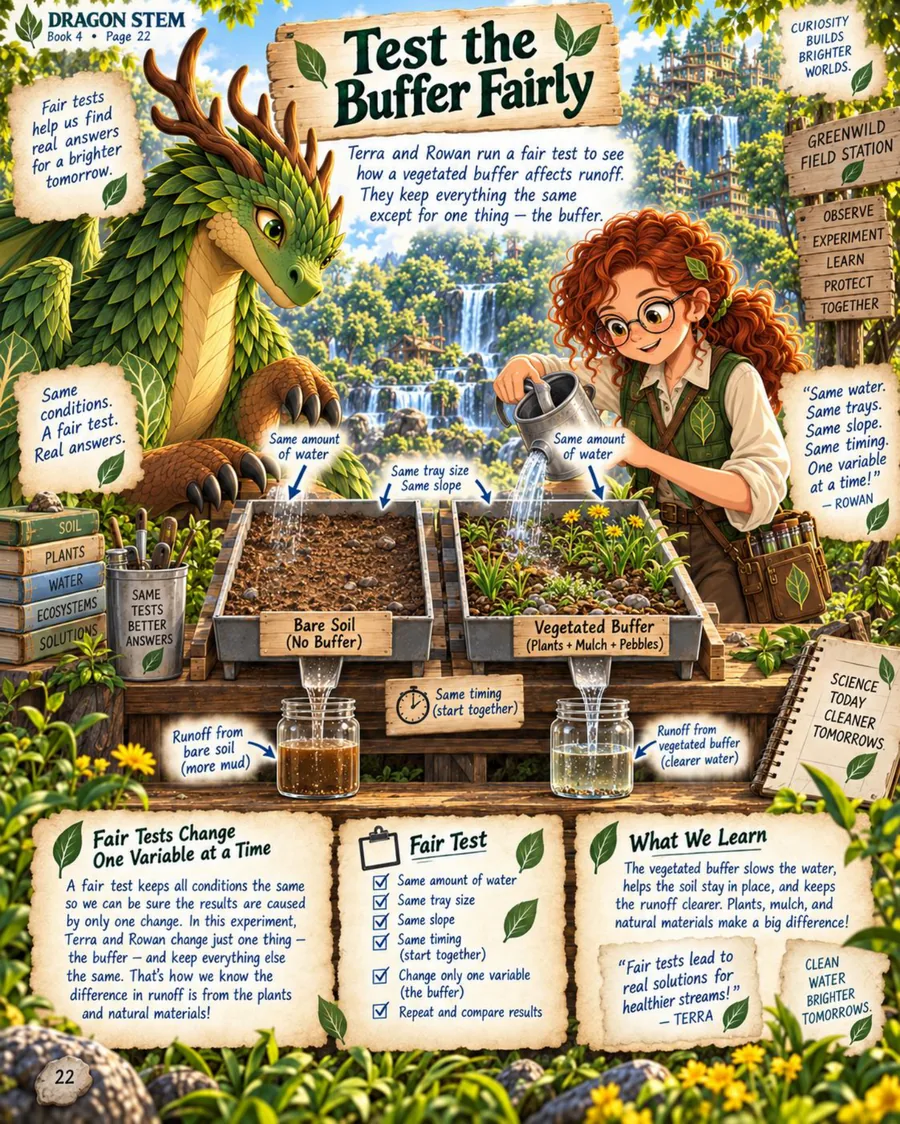
Terra and Rowan run a fair test to see how a vegetated buffer affects runoff.
They keep everything the same except for one thing — the buffer.
Fair tests help us find real answers for a brighter tomorrow.
Same conditions. A fair test. Real answers.
Fair Tests Change One Variable at a Time: A fair test keeps all conditions the same so we can be sure the results are caused by only one change. In this experiment, Terra and Rowan change just one thing — the buffer — and keep everything else the same. That's how we know the difference in runoff is from the plants and natural materials!
Fair Test checklist: Same amount of water. Same tray size. Same slope. Same timing (start together). Change only one variable (the buffer). Repeat and compare results.
Runoff from bare soil (more mud).
Runoff from vegetated buffer (clearer water).
What We Learn: The vegetated buffer slows the water, helps the soil stay in place, and keeps the runoff clearer. Plants, mulch, and natural materials make a big difference!
Rowan: "Same water. Same trays. Same slope. Same timing. One variable at a time!"
Terra: "Fair tests lead to real solutions for healthier streams!"
Read the words
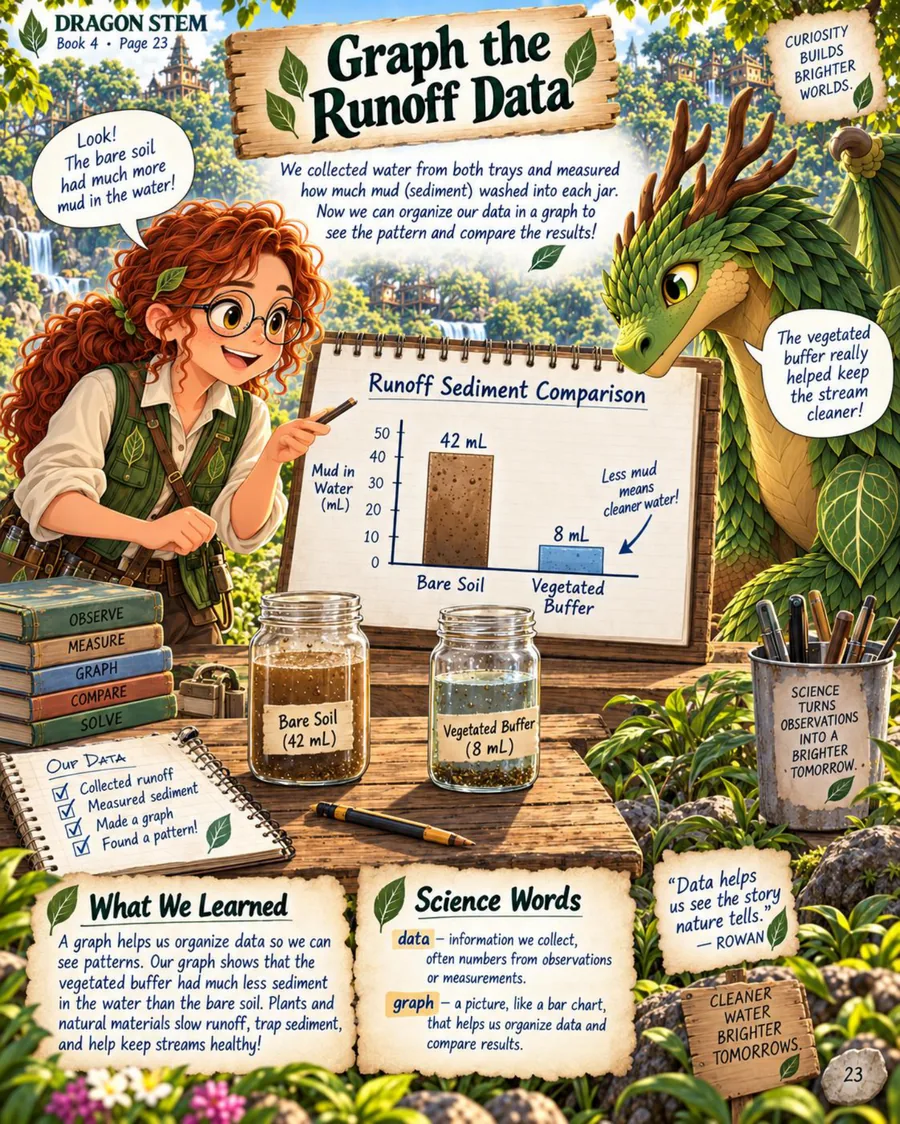
We collected water from both trays and measured how much mud (sediment) washed into each jar.
Now we can organize our data in a graph to see the pattern and compare the results!
Rowan: "Look! The bare soil had much more mud in the water!"
Runoff Sediment Comparison — Mud in Water (mL): Bare Soil 42 mL, Vegetated Buffer 8 mL. Less mud means cleaner water!
Terra: "The vegetated buffer really helped keep the stream cleaner!"
Our Data: Collected runoff. Measured sediment. Made a graph. Found a pattern!
What We Learned: A graph helps us organize data so we can see patterns. Our graph shows that the vegetated buffer had much less sediment in the water than the bare soil. Plants and natural materials slow runoff, trap sediment, and help keep streams healthy!
Science Words — data: information we collect, often numbers from observations or measurements. graph: a picture, like a bar chart, that helps us organize data and compare results.
Rowan: "Data helps us see the story nature tells."
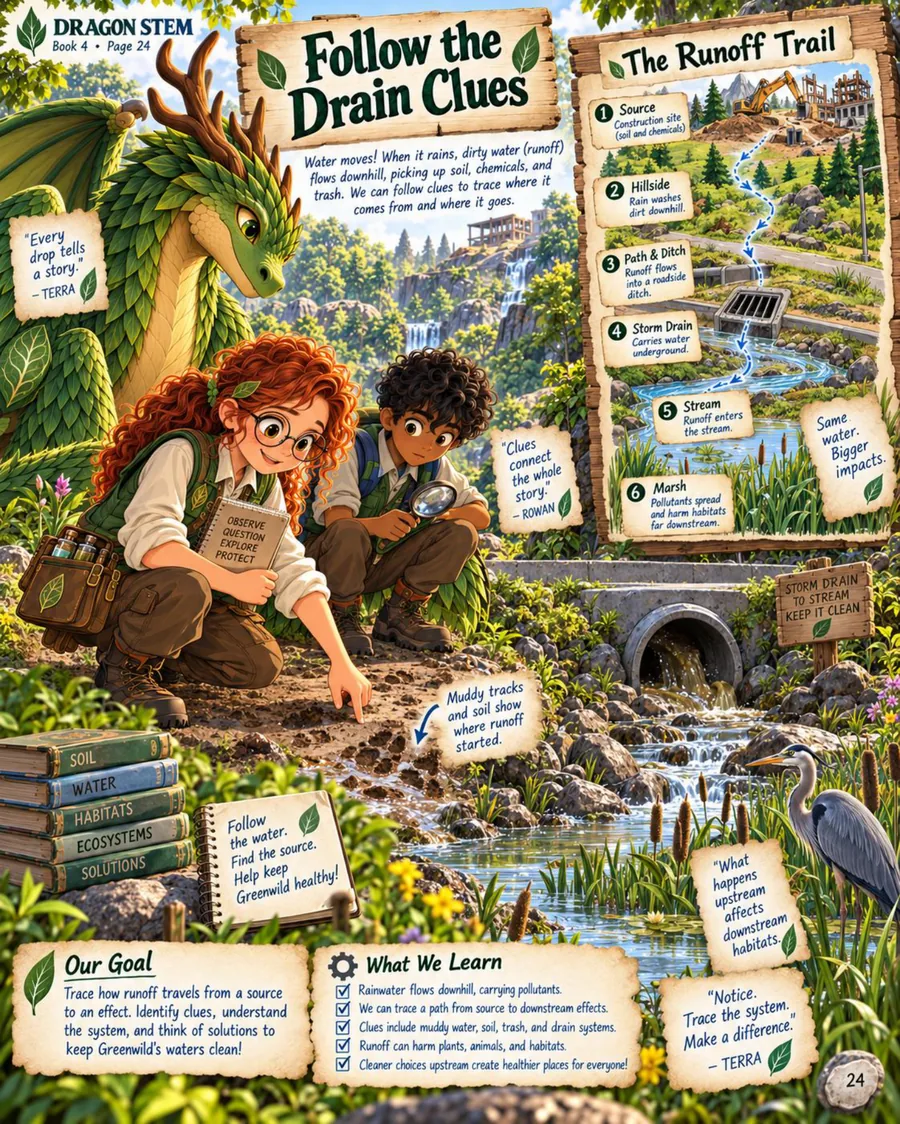
Read the words
Water moves! When it rains, dirty water (runoff) flows downhill, picking up soil, chemicals, and trash.
We can follow clues to trace where it comes from and where it goes.
Terra: "Every drop tells a story."
Rowan: "Clues connect the whole story."
The Runoff Trail — 1 Source: Construction site (soil and chemicals). 2 Hillside: Rain washes dirt downhill. 3 Path & Ditch: Runoff flows into a roadside ditch. 4 Storm Drain: Carries water underground. 5 Stream: Runoff enters the stream. 6 Marsh: Pollutants spread and harm habitats far downstream.
Same water. Bigger impacts.
Storm Drain to Stream — Keep It Clean.
Muddy tracks and soil show where runoff started.
Our Goal: Trace how runoff travels from a source to an effect. Identify clues, understand the system, and think of solutions to keep Greenwild's waters clean!
What We Learn: Rainwater flows downhill, carrying pollutants. We can trace a path from source to downstream effects. Clues include muddy water, soil, trash, and drain systems. Runoff can harm plants, animals, and habitats. Cleaner choices upstream create healthier places for everyone!
Terra: "What happens upstream affects downstream habitats. Notice. Trace the system. Make a difference."
Follow the water. Find the source. Help keep Greenwild healthy!
- Fold 2 paper planes the same way.
- Put a paper clip on the nose of 1 plane.
- Throw each 1 three times, the same way. Which flies farther?
You need: 2 sheets of paper, 1 paper clip.
Throw them where no one is standing.
Can you remember? Tavi changed the filter and moved to a quiet room. Is that test fair?
No. Two things changed, so we can't tell which one helped.
For grown-ups
Learning goal: I can plan a fair test, use its results to compare two solutions, and build a buffer strip.
Grade 4-5.
| Code | Standard |
|---|---|
| 3-5-ETS1-3 | Plan and carry out fair tests in which variables are controlled and failure points are considered to identify aspects of a model or prototype that can be improved. |
| 3-5-ETS1-2 | Generate and compare multiple possible solutions to a problem based on how well each is likely to meet the criteria and constraints of the problem. |
| 3.MD.B.3 | Draw a scaled picture graph and a scaled bar graph to represent a data set with several categories. Solve one- and two-step "how many more" and "how many less" problems using information presented in scaled bar graphs. |
| 4-ESS2-1 | Make observations and/or measurements to provide evidence of the effects of weathering or the rate of erosion by water, ice, wind, or vegetation. |
Talk about it:
- Ask your child what a 'fair test' means and why scientists change only one thing at a time.
- Look at a slope near your home: would plants or bare dirt hold the soil better after rain?
About 10 minutes.
How the game teaches it: evidence first, then the rider's hints (never the answer); no stars, scores or timers.
The full teacher guide is in the book.
Only the pages from this mission are shown here. From the Dragon STEM series by Adisak Sukul.