Dragon STEM · Read it in the book
Play the gameYour game is still open. Switch to its tab.

Water moves soil
Moving water can carry soil from one place to another. Rowan and Terra watched water move soil downstream. A bare slope loses more soil than a planted one.
Word: Erosion: when wind or water wears away and carries soil.
Read the words
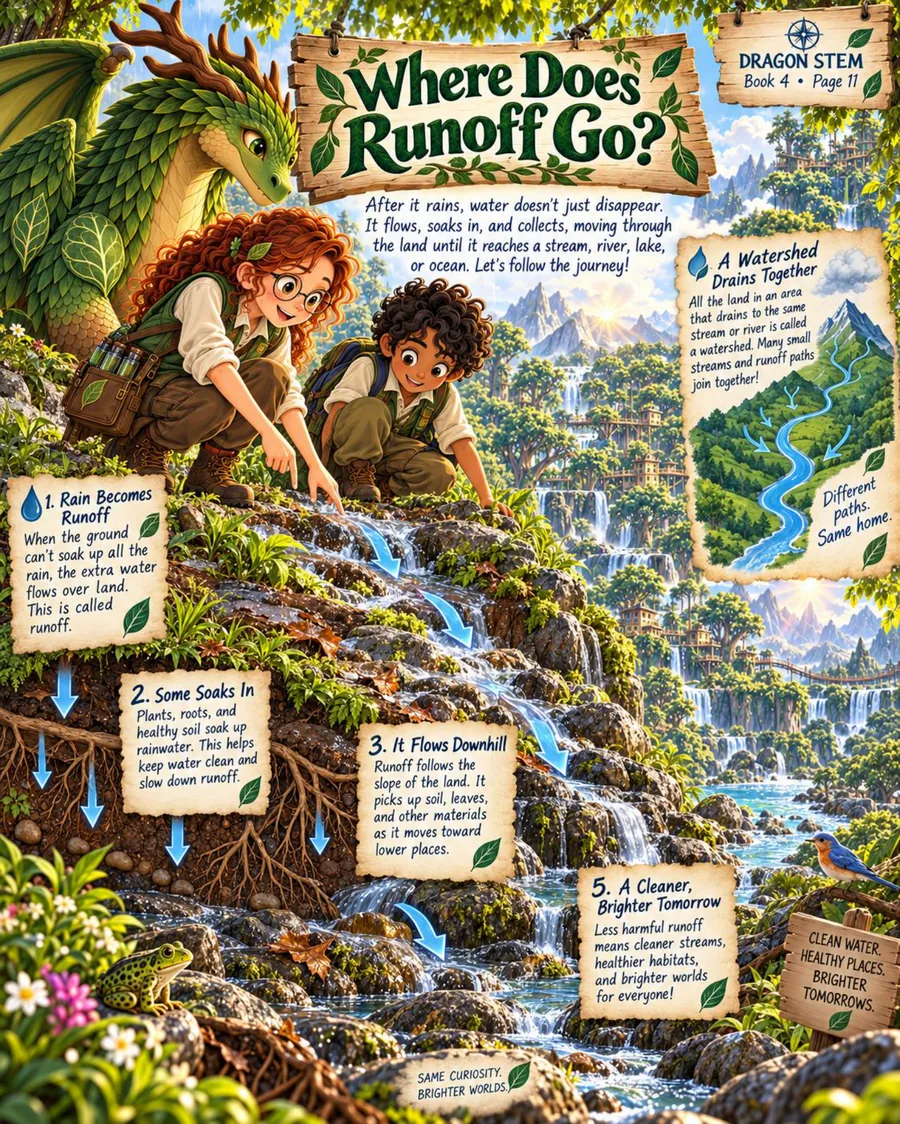
After it rains, water doesn't just disappear.
It flows, soaks in, and collects, moving through the land until it reaches a stream, river, lake, or ocean.
Let's follow the journey!
1. Rain Becomes Runoff: When the ground can't soak up all the rain, the extra water flows over land. This is called runoff.
2. Some Soaks In: Plants, roots, and healthy soil soak up rainwater. This helps keep water clean and slow down runoff.
3. It Flows Downhill: Runoff follows the slope of the land. It picks up soil, leaves, and other materials as it moves toward lower places.
A Watershed Drains Together: All the land in an area that drains to the same stream or river is called a watershed. Many small streams and runoff paths join together! Different paths. Same home.
5. A Cleaner, Brighter Tomorrow: Less harmful runoff means cleaner streams, healthier habitats, and brighter worlds for everyone!
Read the words
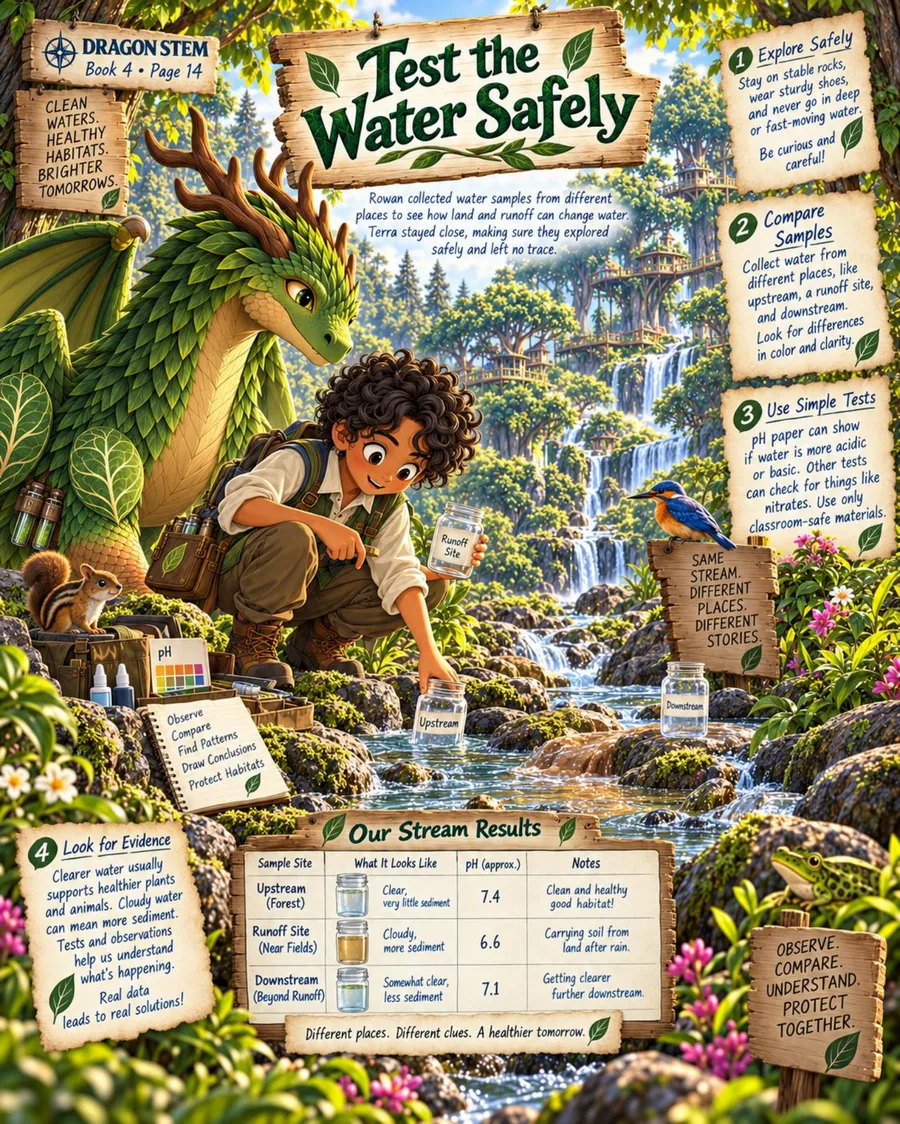
Rowan collected water samples from different places to see how land and runoff can change water.
Terra stayed close, making sure they explored safely and left no trace.
1 Explore Safely: Stay on stable rocks, wear sturdy shoes, and never go in deep or fast-moving water. Be curious and careful!
2 Compare Samples: Collect water from different places, like upstream, a runoff site, and downstream. Look for differences in color and clarity.
3 Use Simple Tests: pH paper can show if water is more acidic or basic. Other tests can check for things like nitrates. Use only classroom-safe materials.
4 Look for Evidence: Clearer water usually supports healthier plants and animals. Cloudy water can mean more sediment. Tests and observations help us understand what's happening. Real data leads to real solutions!
Same stream. Different places. Different stories.
Our Stream Results — Upstream (Forest): Clear, very little sediment. pH (approx.) 7.4. Notes: Clean and healthy, good habitat!
Runoff Site (Near Fields): Cloudy, more sediment. pH (approx.) 6.6. Notes: Carrying soil from land after rain.
Downstream (Beyond Runoff): Somewhat clear, less sediment. pH (approx.) 7.1. Notes: Getting clearer further downstream.
Different places. Different clues. A healthier tomorrow.
Real-world note. Grown-ups use special strips to test pH. We test by looking instead.
For grown-ups
This page's water-quality table includes a pH reading. Testing pH safely needs training and the right strips, and pH is a grade 6-8 standard, so the game's own version of this test uses only safe, grade 3-5 clues: color, clarity and how many small animals a sample has.
Read the words
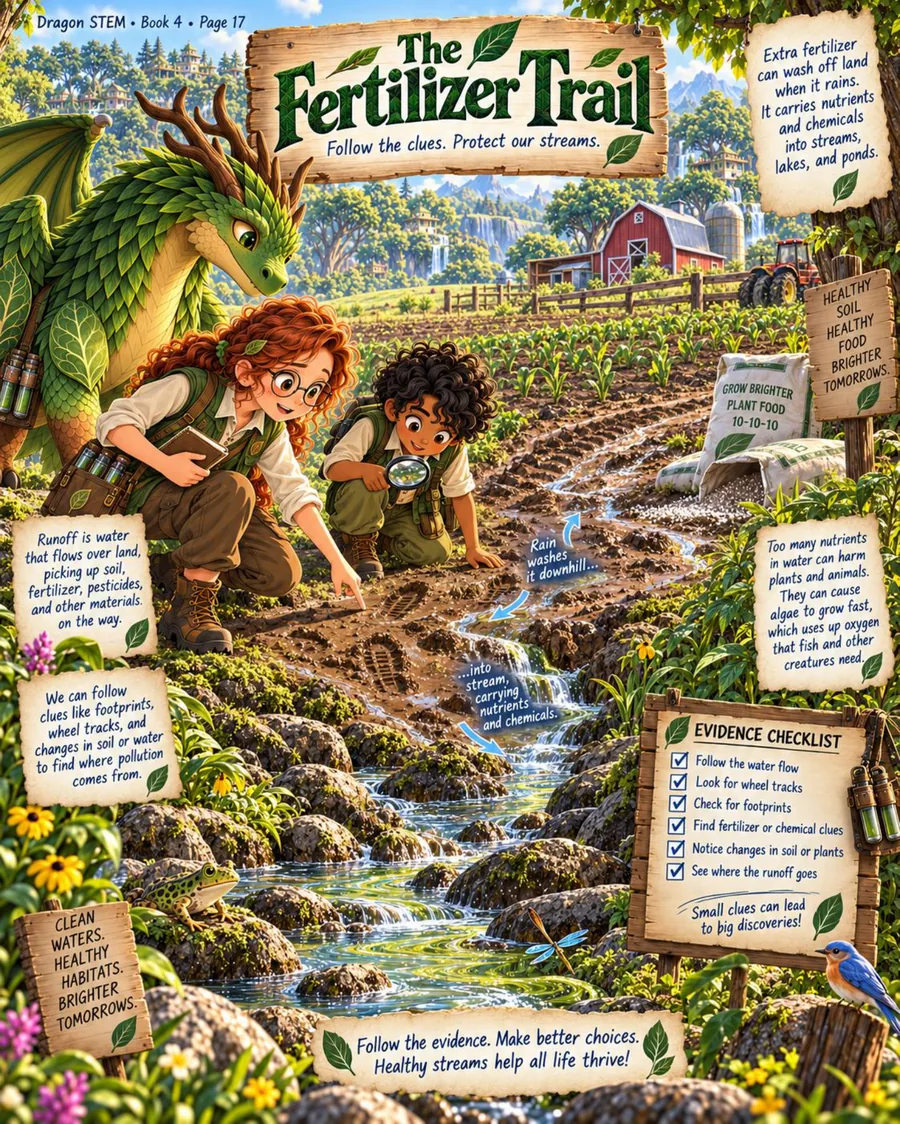
Follow the clues. Protect our streams.
Runoff is water that flows over land, picking up soil, fertilizer, pesticides, and other materials on the way.
We can follow clues like footprints, wheel tracks, and changes in soil or water to find where pollution comes from.
Grow Brighter Plant Food, 10-10-10.
Rain washes it downhill... into stream, carrying nutrients and chemicals.
Extra fertilizer can wash off land when it rains. It carries nutrients and chemicals into streams, lakes, and ponds.
Too many nutrients in water can harm plants and animals. They can cause algae to grow fast, which uses up oxygen that fish and other creatures need.
Evidence Checklist: Follow the water flow. Look for wheel tracks. Check for footprints. Find fertilizer or chemical clues. Notice changes in soil or plants. See where the runoff goes.
Small clues can lead to big discoveries!
Follow the evidence. Make better choices. Healthy streams help all life thrive!
- Fill 2 cups with the same amount of dry soil.
- Push a few small stones or grass clumps into only 1 cup.
- Tip both cups the same amount and pour a little water on top.
- Which cup loses less soil?
You need: 2 cups, dry soil, small stones or grass clumps, water.
Ask a grown-up first. Do this outside or over a tray.
Can you remember? A hill has no plants. Rain falls hard. What happens to its soil?
Rain can carry the loose soil downhill. Plants would hold it back.
For grown-ups
Learning goal: I can compare clarity readings from 3 places to find where soil enters a stream and explain why the water clears downstream.
Grade 4.
| Code | Standard |
|---|---|
| 4-ESS2-1 | Make observations and/or measurements to provide evidence of the effects of weathering or the rate of erosion by water, ice, wind, or vegetation. |
| 5-ESS3-1 | Obtain and combine information about ways individual communities use science ideas to protect the Earth's resources and environment. |
| MP6 | Attend to precision. |
Talk about it:
- Walk a local creek or ditch after rain; how does the water's clarity change in different spots?
- Ask why water can get clearer again downstream, with no one cleaning it.
About 8 minutes.
How the game teaches it: evidence first, then the rider's hints (never the answer); no stars, scores or timers.
The full teacher guide is in the book.
Only the pages from this mission are shown here. From the Dragon STEM series by Adisak Sukul.