Dragon STEM · Read it in the book
Play the gameYour game is still open. Switch to its tab.

Water moves soil
Moving water can carry soil from one place to another. Rowan and Terra watched water move soil downstream. A bare slope loses more soil than a planted one.
Word: Erosion: when wind or water wears away and carries soil.
Read the words
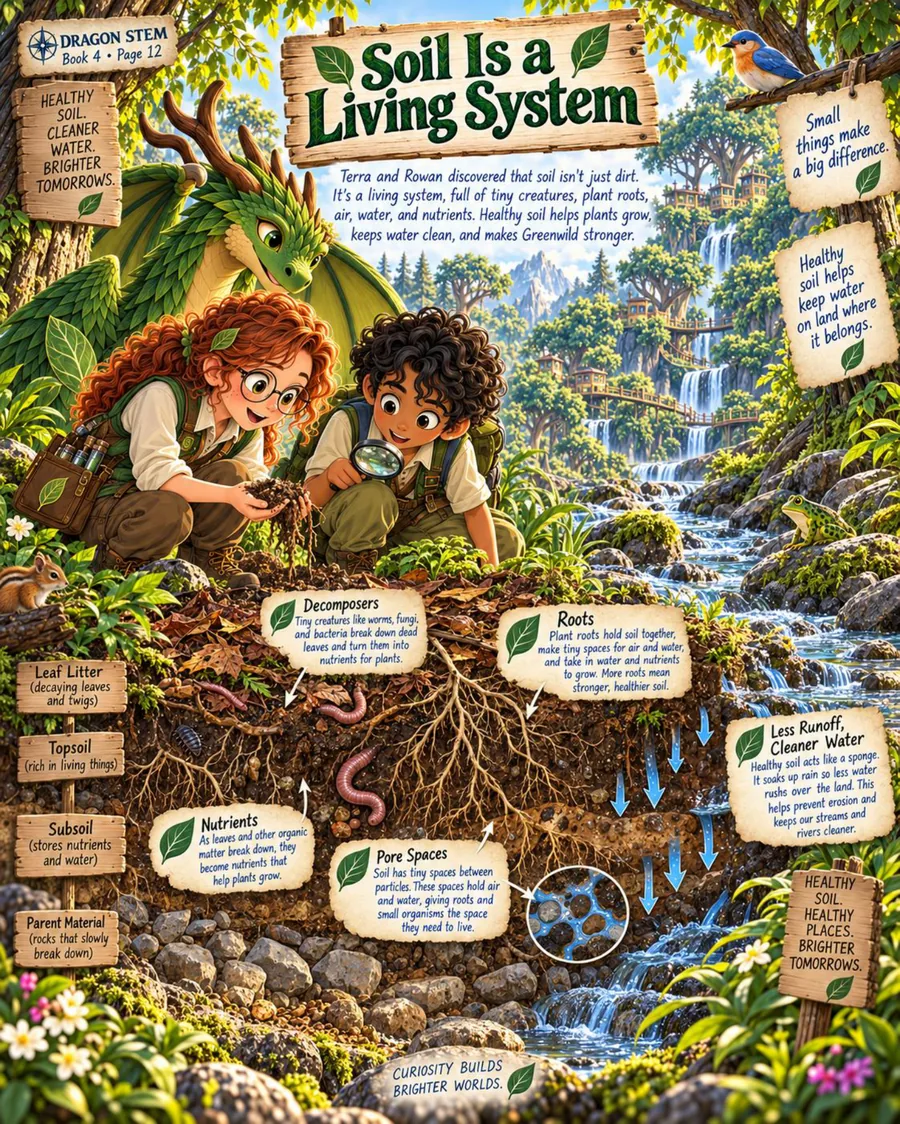
Terra and Rowan discovered that soil isn't just dirt.
It's a living system, full of tiny creatures, plant roots, air, water, and nutrients.
Healthy soil helps plants grow, keeps water clean, and makes Greenwild stronger.
Layers, top to bottom: Leaf Litter (decaying leaves and twigs). Topsoil (rich in living things). Subsoil (stores nutrients and water). Parent Material (rocks that slowly break down).
Decomposers: Tiny creatures like worms, fungi, and bacteria break down dead leaves and turn them into nutrients for plants.
Roots: Plant roots hold soil together, make tiny spaces for air and water, and take in water and nutrients to grow. More roots mean stronger, healthier soil.
Nutrients: As leaves and other organic matter break down, they become nutrients that help plants grow.
Pore Spaces: Soil has tiny spaces between particles. These spaces hold air and water, giving roots and small organisms the space they need to live.
Less Runoff, Cleaner Water: Healthy soil acts like a sponge. It soaks up rain so less water rushes over the land. This helps prevent erosion and keeps our streams and rivers cleaner.
Small things make a big difference. Healthy soil helps keep water on land where it belongs.
Read the words
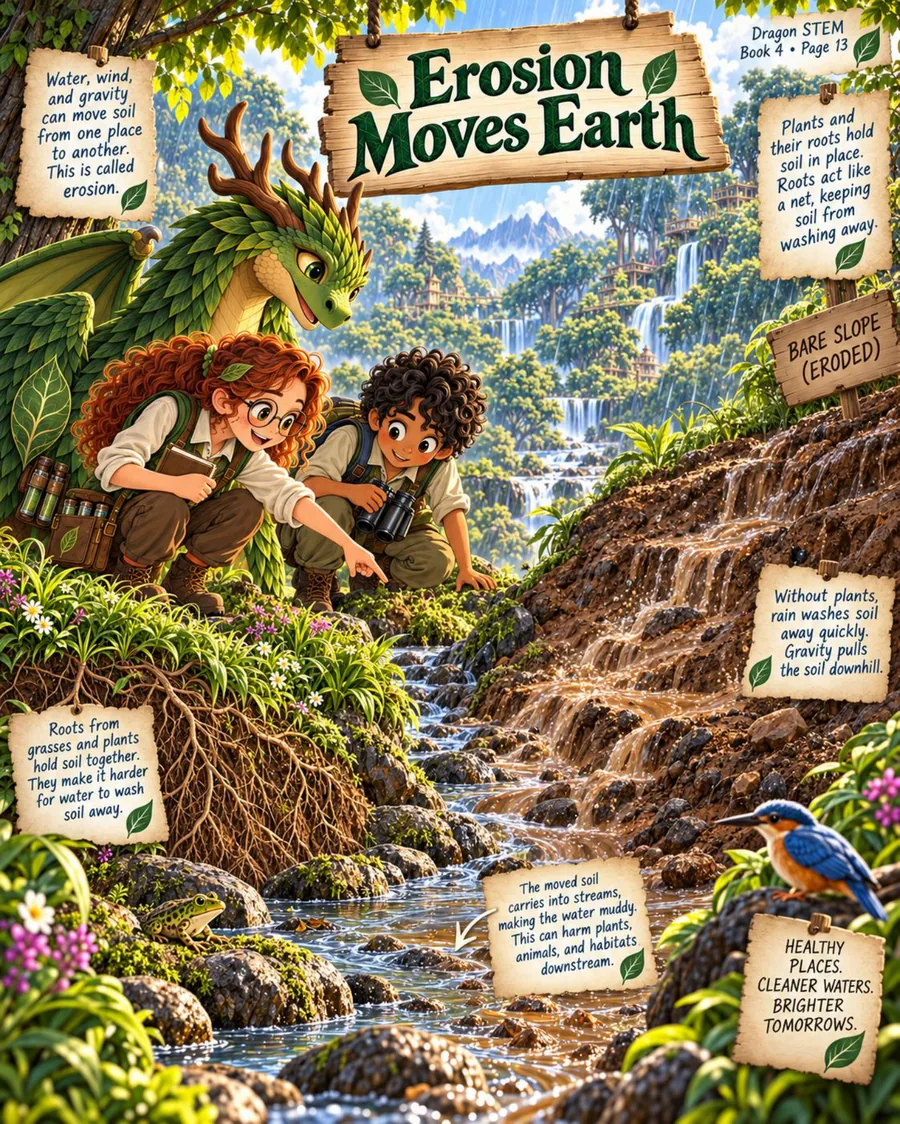
Water, wind, and gravity can move soil from one place to another. This is called erosion.
Plants and their roots hold soil in place. Roots act like a net, keeping soil from washing away.
Roots from grasses and plants hold soil together. They make it harder for water to wash soil away.
Bare Slope (Eroded).
Without plants, rain washes soil away quickly. Gravity pulls the soil downhill.
The moved soil carries into streams, making the water muddy. This can harm plants, animals, and habitats downstream.
Healthy places. Cleaner waters. Brighter tomorrows.
Read the words
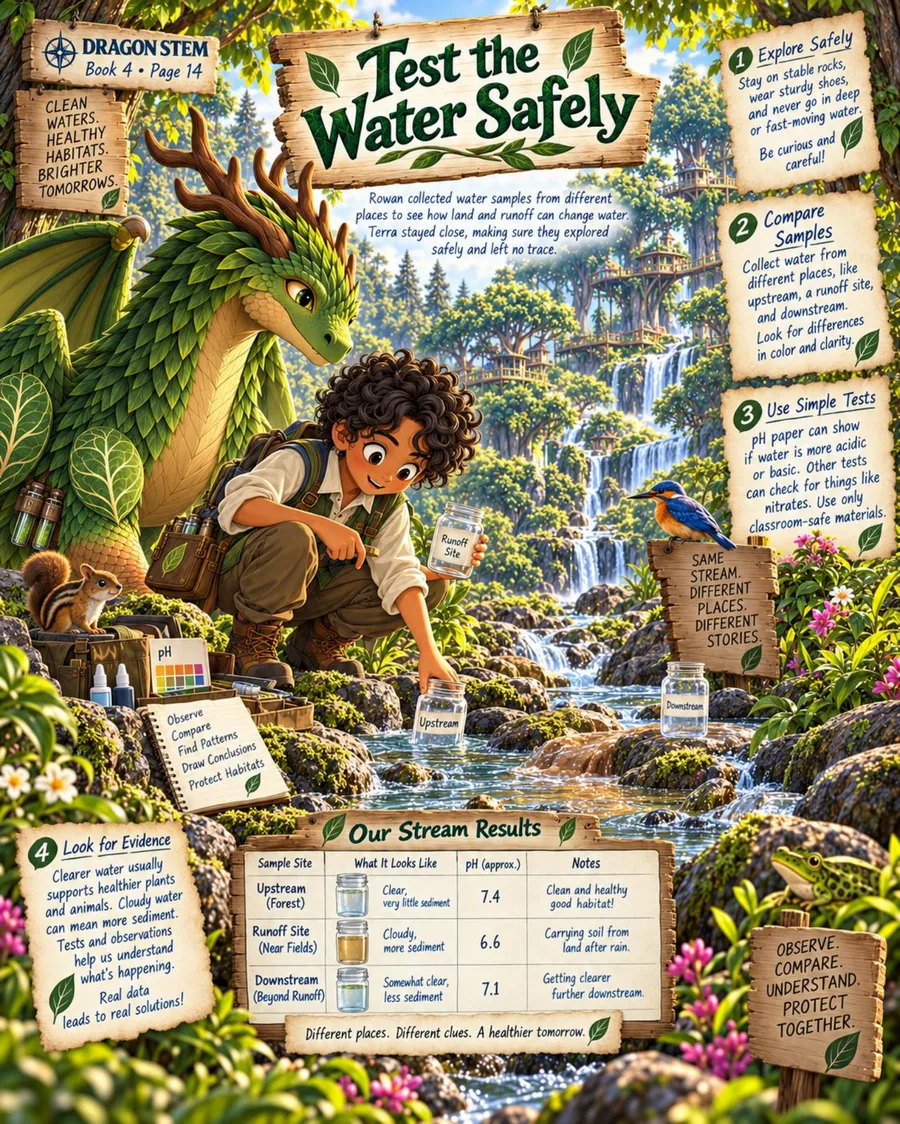
Rowan collected water samples from different places to see how land and runoff can change water.
Terra stayed close, making sure they explored safely and left no trace.
1 Explore Safely: Stay on stable rocks, wear sturdy shoes, and never go in deep or fast-moving water. Be curious and careful!
2 Compare Samples: Collect water from different places, like upstream, a runoff site, and downstream. Look for differences in color and clarity.
3 Use Simple Tests: pH paper can show if water is more acidic or basic. Other tests can check for things like nitrates. Use only classroom-safe materials.
4 Look for Evidence: Clearer water usually supports healthier plants and animals. Cloudy water can mean more sediment. Tests and observations help us understand what's happening. Real data leads to real solutions!
Same stream. Different places. Different stories.
Our Stream Results — Upstream (Forest): Clear, very little sediment. pH (approx.) 7.4. Notes: Clean and healthy, good habitat!
Runoff Site (Near Fields): Cloudy, more sediment. pH (approx.) 6.6. Notes: Carrying soil from land after rain.
Downstream (Beyond Runoff): Somewhat clear, less sediment. pH (approx.) 7.1. Notes: Getting clearer further downstream.
Different places. Different clues. A healthier tomorrow.
Real-world note. Grown-ups use special strips to test pH. We test by looking instead.
For grown-ups
This page's water-quality table includes a pH reading. Testing pH safely needs training and the right strips, and pH is a grade 6-8 standard, so the game's own version of this test uses only safe, grade 3-5 clues: color, clarity and how many small animals a sample has.
- Fill 2 cups with the same amount of dry soil.
- Push a few small stones or grass clumps into only 1 cup.
- Tip both cups the same amount and pour a little water on top.
- Which cup loses less soil?
You need: 2 cups, dry soil, small stones or grass clumps, water.
Ask a grown-up first. Do this outside or over a tray.
Can you remember? A hill has no plants. Rain falls hard. What happens to its soil?
Rain can carry the loose soil downhill. Plants would hold it back.
For grown-ups
Learning goal: I can record observations at 4 places and pick the observation that best explains the cloudy stream.
Grade 3-5.
| Code | Standard |
|---|---|
| 4-ESS2-1 | Make observations and/or measurements to provide evidence of the effects of weathering or the rate of erosion by water, ice, wind, or vegetation. |
| 5-ESS2-1 | Develop a model using an example to describe ways the geosphere, biosphere, hydrosphere, and/or atmosphere interact. |
| 5-LS2-1 | Develop a model to describe the movement of matter among plants, animals, decomposers, and the environment. |
| 4-LS1-1 | Construct an argument that plants and animals have internal and external structures that function to support survival, growth, behavior, and reproduction. |
Talk about it:
- Ask your child to describe a time they noticed something change outdoors, then guess why, before checking.
- Together, find a bare patch of soil nearby; what happens to it after rain?
About 5 minutes.
How the game teaches it: evidence first, then the rider's hints (never the answer); no stars, scores or timers.
The full teacher guide is in the book.
Only the pages from this mission are shown here. From the Dragon STEM series by Adisak Sukul.