Dragon STEM · Read it in the book
Play the gameYour game is still open. Switch to its tab.

Group by body parts
Scientists sort living things into groups. They look at the body parts the animals share. Fish have fins and breathe with gills.
Word: Classify: to sort living things into groups by what they share.
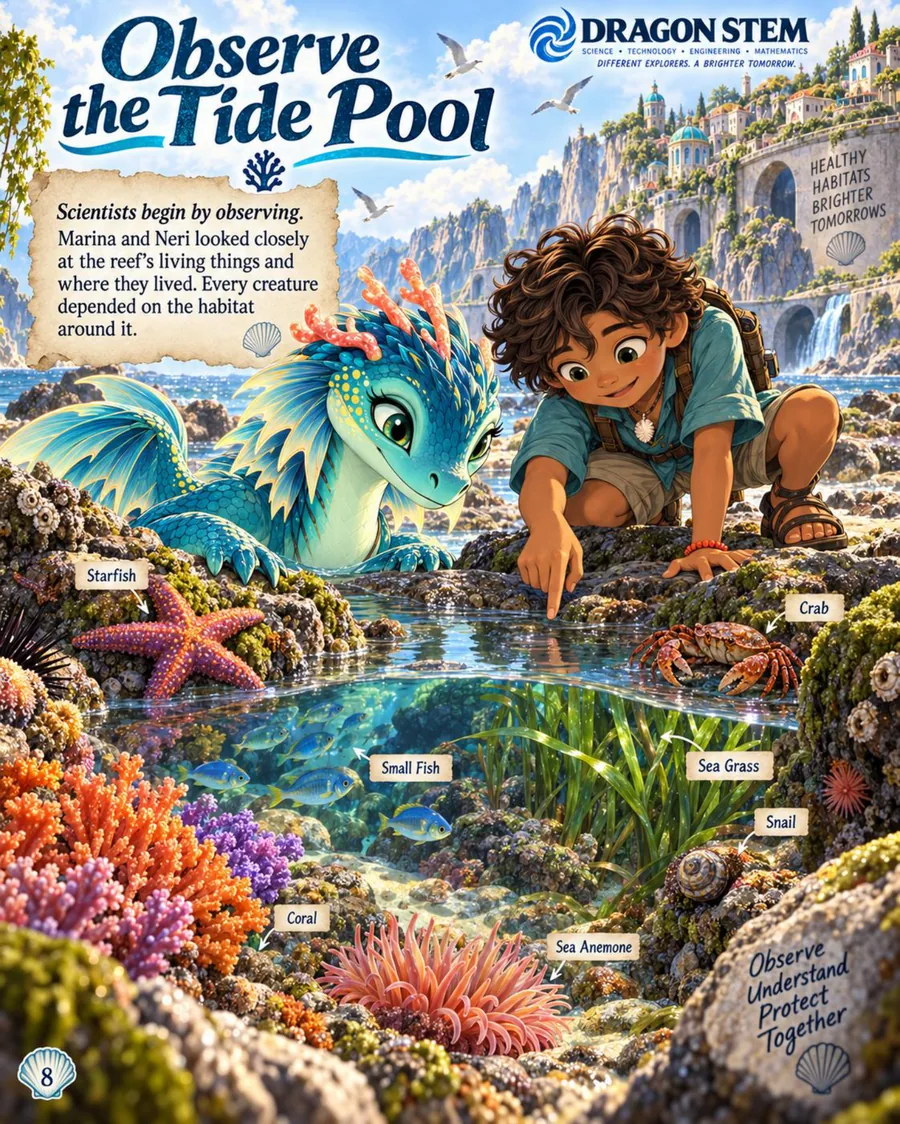
Read the words
Scientists begin by observing.
Marina and Neri looked closely at the reef's living things and where they lived.
Every creature depended on the habitat around it.
Tide pool life: Starfish. Crab. Small Fish. Sea Grass. Snail. Coral. Sea Anemone.
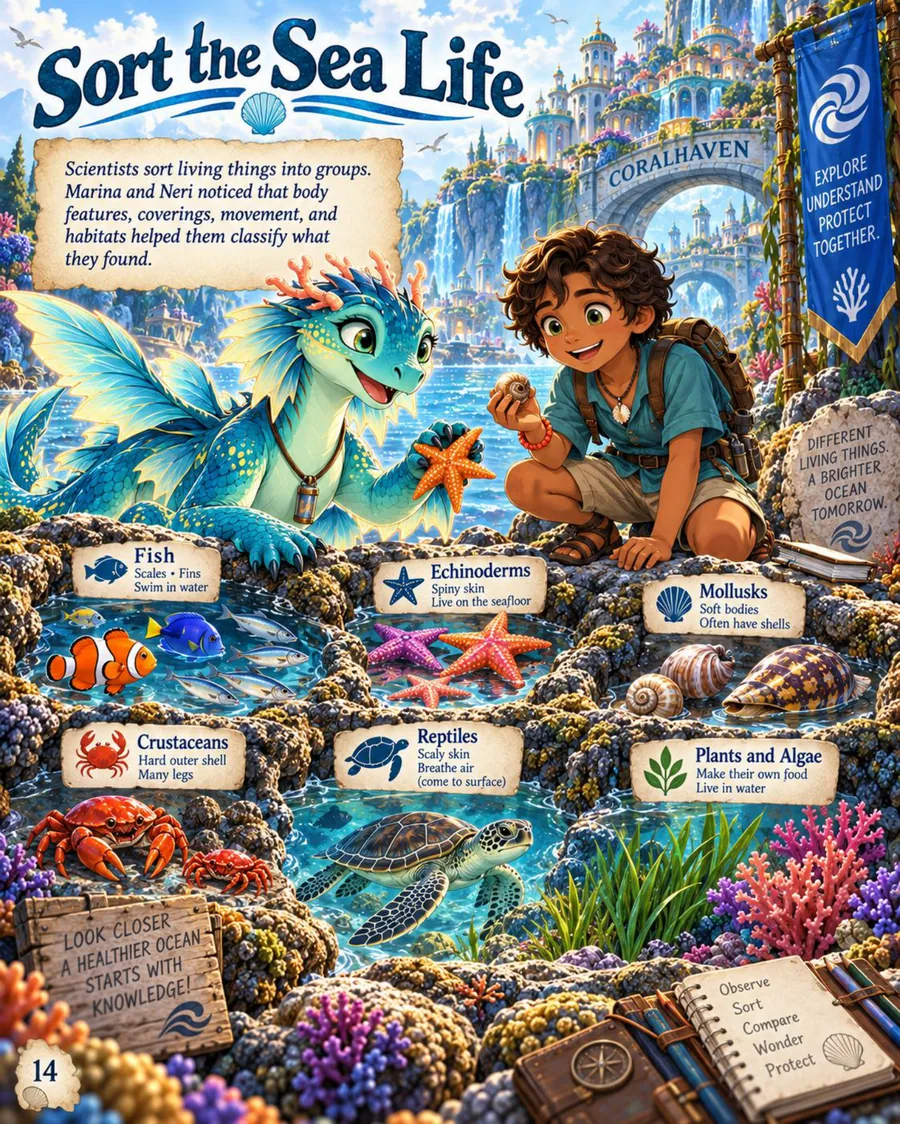
Read the words
Scientists sort living things into groups.
Marina and Neri noticed that body features, coverings, movement, and habitats helped them classify what they found.
Fish: Scales. Fins. Swim in water.
Echinoderms: Spiny skin. Live on the seafloor.
Mollusks: Soft bodies. Often have shells.
Crustaceans: Hard outer shell. Many legs.
Reptiles: Scaly skin. Breathe air (come to surface).
Plants and Algae: Make their own food. Live in water.
- Look at 4 toy animals, or pictures of animals.
- Check each one for fins, a shell, legs or scales.
- Sort them into groups by what they share.
You need: 4 toy animals or animal pictures.
Can you remember? A sea animal has a hard shell and many legs. Which group is it in?
Crustaceans. They have a hard shell and many legs.
For grown-ups
Learning goal: I can sort sea animals into groups by their body parts.
Grade 3-5.
| Code | Standard |
|---|---|
| CCC-PAT | NGSS crosscutting concept, Patterns, grades 3-5: Similarities and differences in patterns can be used to sort, classify, communicate and analyze simple rates of change for natural phenomena and designed products. |
| 4-LS1-1 | Construct an argument that plants and animals have internal and external structures that function to support survival, growth, behavior, and reproduction. |
| 3-LS4-3 | Construct an argument with evidence that in a particular habitat some organisms can survive well, some survive less well, and some cannot survive at all. |
Talk about it:
- What other ways could you group this same set of animals?
- Why do scientists use shared body features, not color or size, to classify animals?
About 7 minutes.
How the game teaches it: evidence first, then the rider's hints (never the answer); no stars, scores or timers.
The full teacher guide is in the book.
Only the pages from this mission are shown here. From the Dragon STEM series by Adisak Sukul.