Dragon STEM · Read it in the book
Play the gameYour game is still open. Switch to its tab.

Balanced or unbalanced?
A force is a push or a pull. Balanced pushes keep an object's motion the same. Unbalanced pushes change how something moves.
Word: Force: a push or a pull.
Read the words
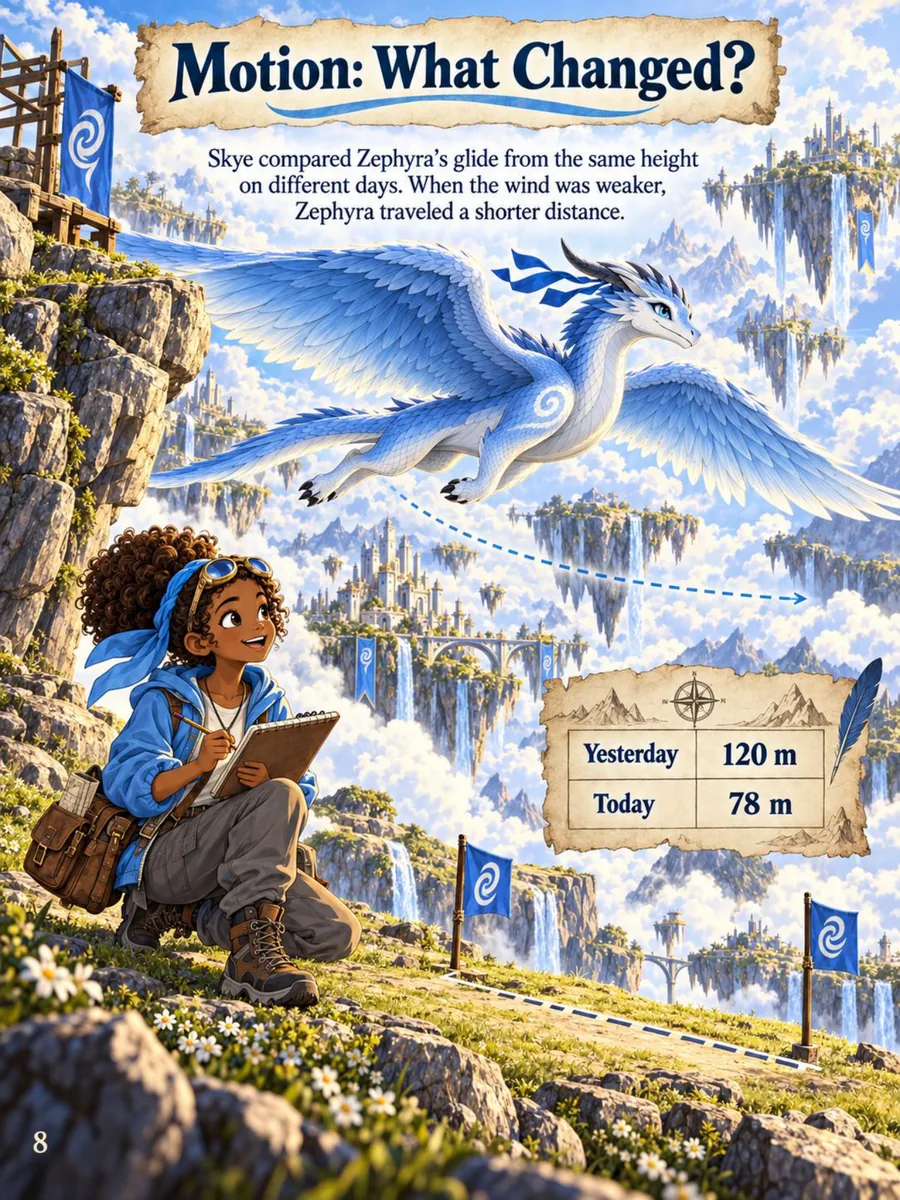
Skye compared Zephyra's glide from the same height on different days.
When the wind was weaker, Zephyra traveled a shorter distance.
Glide distance — Yesterday: 120 m. Today: 78 m.
Read the words
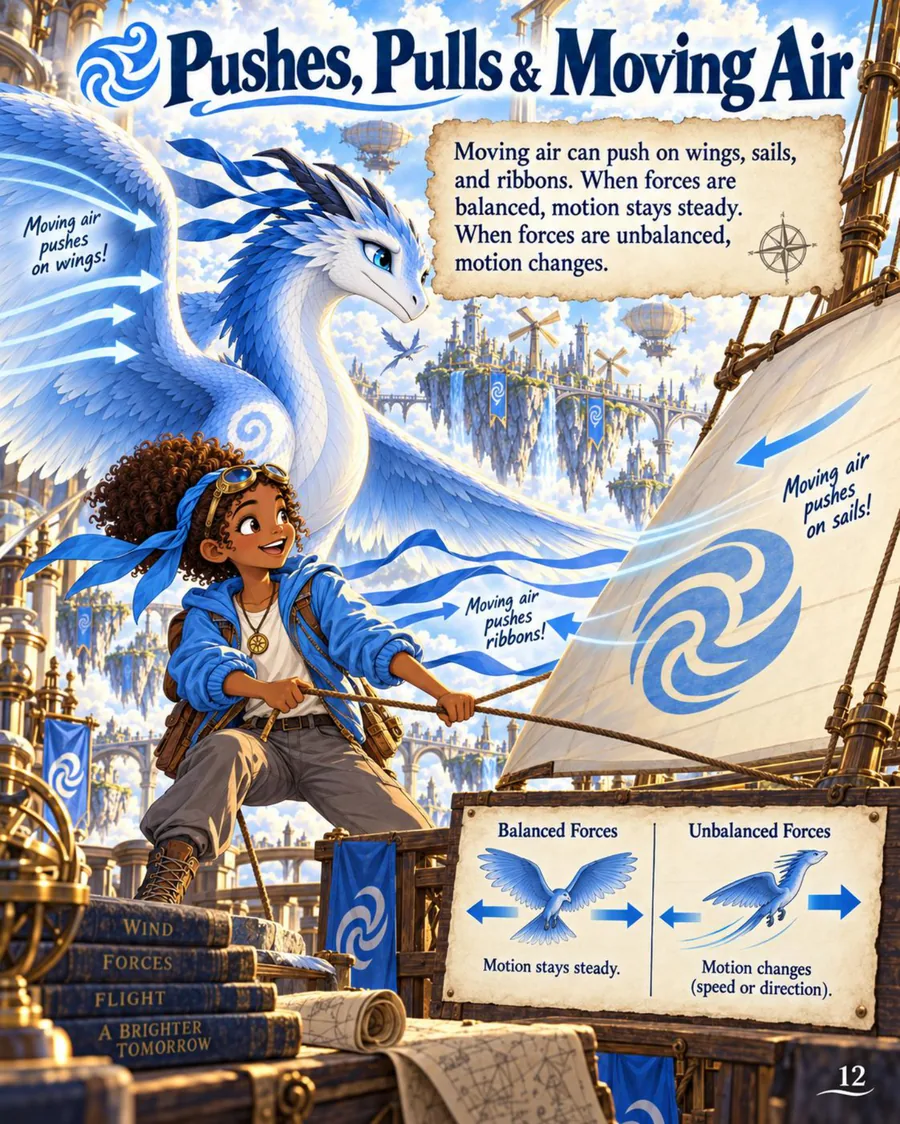
Moving air can push on wings, sails, and ribbons.
When forces are balanced, motion stays steady.
When forces are unbalanced, motion changes.
Moving air pushes on wings! Moving air pushes on sails! Moving air pushes ribbons!
Balanced Forces: Motion stays steady. Unbalanced Forces: Motion changes (speed or direction).
Read the words
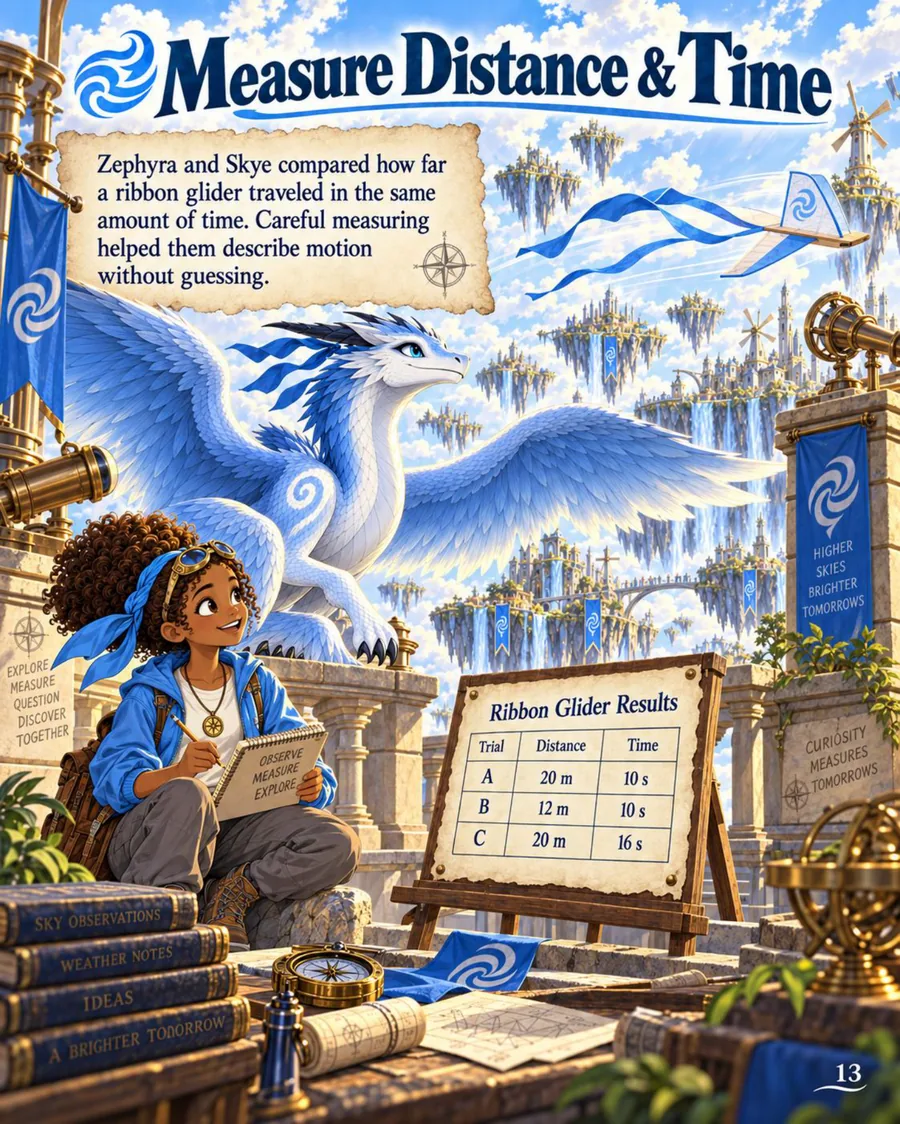
Zephyra and Skye compared how far a ribbon glider traveled in the same amount of time.
Careful measuring helped them describe motion without guessing.
Ribbon Glider Results — Trial A: Distance 20 m, Time 10 s. Trial B: Distance 12 m, Time 10 s. Trial C: Distance 20 m, Time 16 s.
- Set a light box on a smooth floor.
- Two people push it from opposite sides, with the same push. Does it move?
- Now 1 person pushes harder. What happens?
You need: a light cardboard box, a friend or a grown-up.
Use a light box on a clear floor. Push gently.
Can you remember? A flag hangs still in calm air. A sudden gust flips it. Which push was unbalanced?
The gust. It changed the flag's motion.
For grown-ups
Learning goal: I can compare glide trials that share the same time or the same distance, and use balanced and unbalanced forces to explain a change.
Grade 3.
| Code | Standard |
|---|---|
| 3-PS2-1 | Plan and conduct an investigation to provide evidence of the effects of balanced and unbalanced forces on the motion of an object. |
| 3-PS2-2 | Make observations and/or measurements of an object's motion to provide evidence that a pattern can be used to predict future motion. |
| 3.NBT.A.2 | Fluently add and subtract within 1000 using strategies and algorithms based on place value, properties of operations, and/or the relationship between addition and subtraction. |
Talk about it:
- Push a toy or a paper glider gently, then push it harder: how does the push change what happens?
- Why does comparing 2 trials with the same time (or the same distance) work without ever computing a speed?
About 8 minutes.
How the game teaches it: evidence first, then the rider's hints (never the answer); no stars, scores or timers.
The full teacher guide is in the book.
Only the pages from this mission are shown here. From the Dragon STEM series by Adisak Sukul.