Dragon STEM · Read it in the book
Play the gameYour game is still open. Switch to its tab.

Goals and limits
Criteria are what a design must do. Constraints are the limits we must follow. A filter's criterion is to catch ash. A constraint is using only what we have.
Word: Criteria: what a design must do to succeed.
Read the words
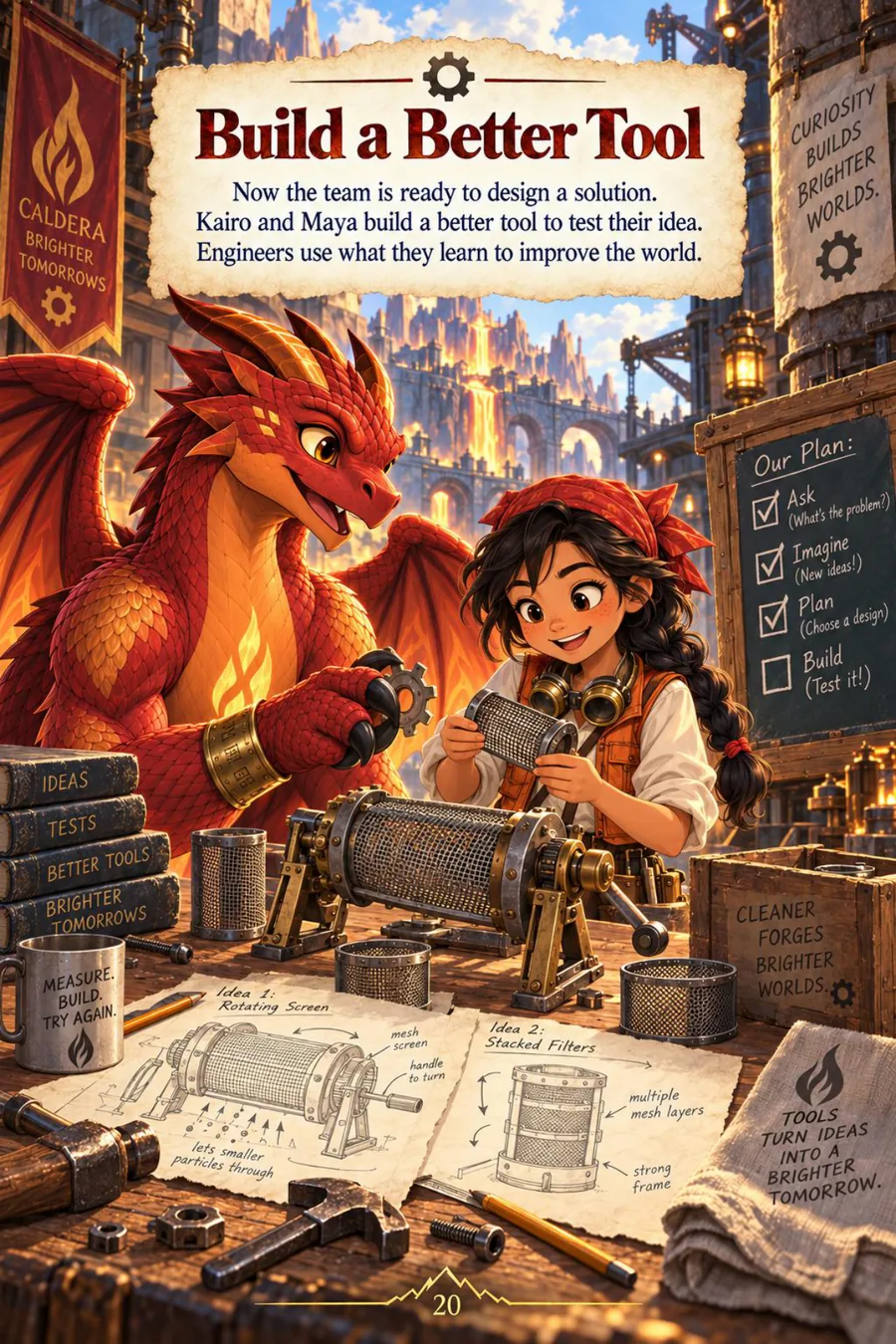
Now the team is ready to design a solution.
Kairo and Maya build a better tool to test their idea.
Engineers use what they learn to improve the world.
Our Plan: Ask (What's the problem?). Imagine (New ideas!). Plan (Choose a design). Build (Test it!).
Idea 1: Rotating Screen — mesh screen, handle to turn, lets smaller particles through.
Idea 2: Stacked Filters — multiple mesh layers, strong frame.
Read the words
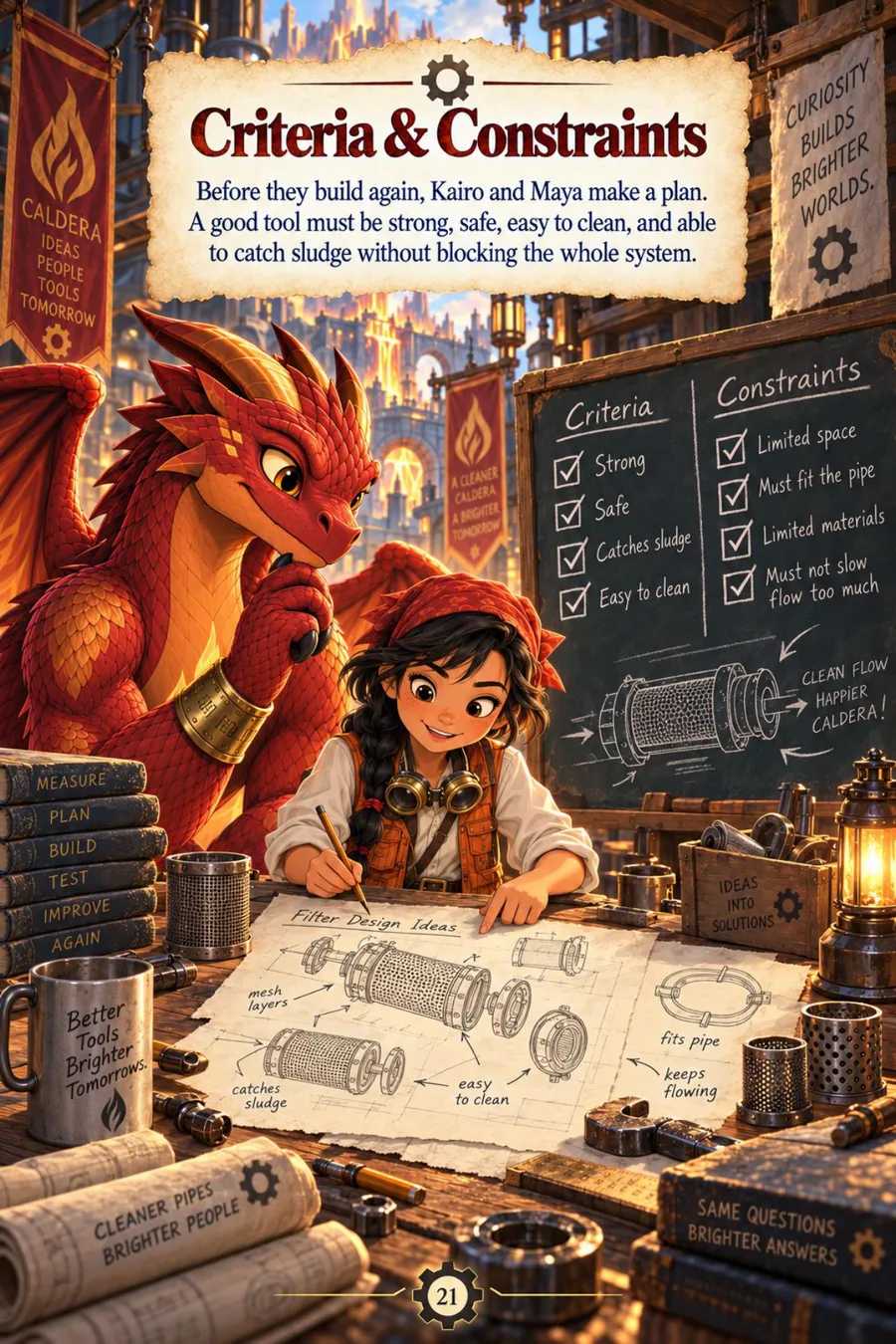
Before they build again, Kairo and Maya make a plan.
A good tool must be strong, safe, easy to clean, and able to catch sludge without blocking the whole system.
Criteria: Strong. Safe. Catches sludge. Easy to clean.
Constraints: Limited space. Must fit the pipe. Limited materials. Must not slow flow too much.
Filter Design Ideas: mesh layers, catches sludge, easy to clean, fits pipe, keeps flowing.
Clean flow, happier Caldera!
Read the words
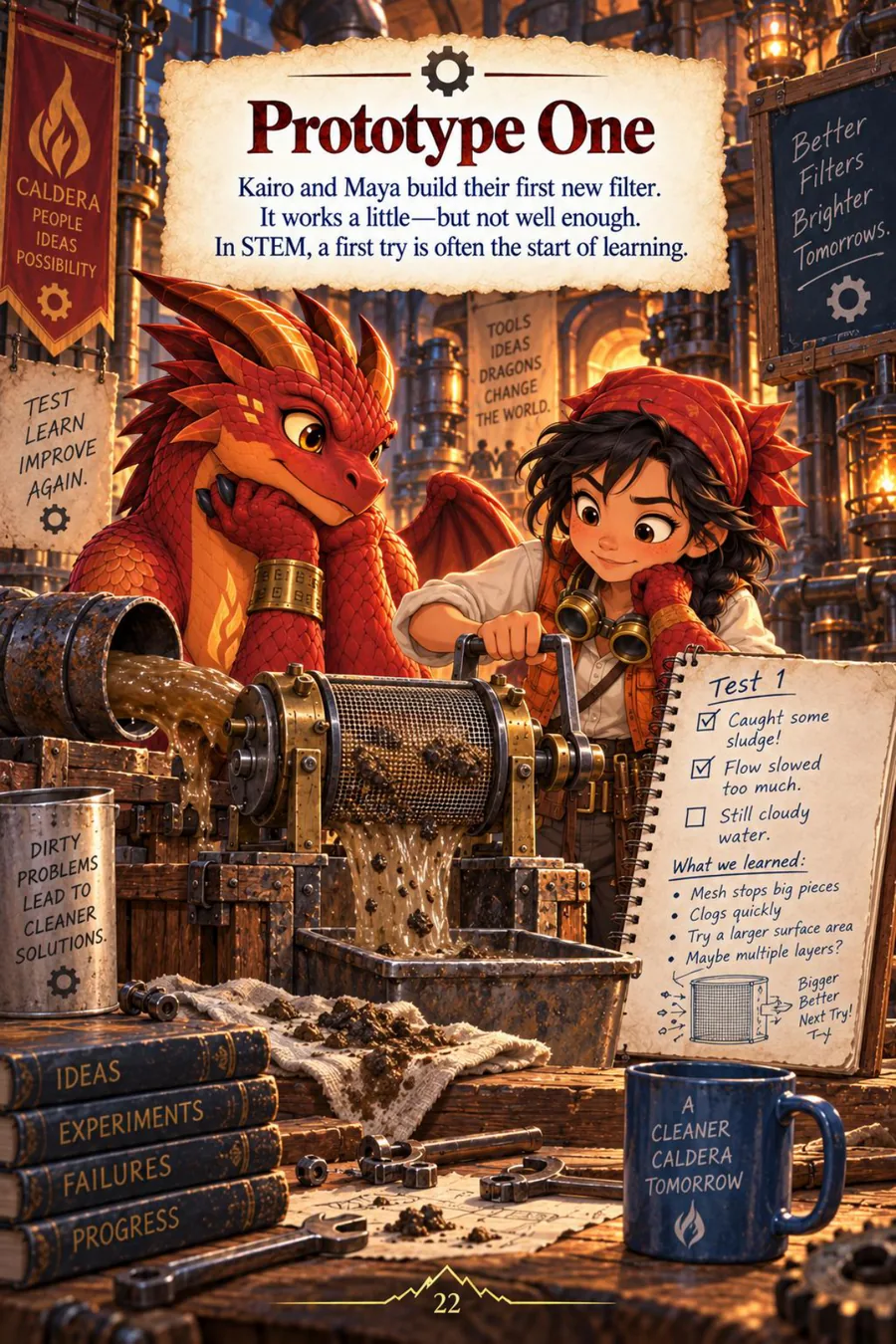
Kairo and Maya build their first new filter.
It works a little—but not well enough.
In STEM, a first try is often the start of learning.
Test 1: Caught some sludge! Flow slowed too much. Still cloudy water.
What we learned: Mesh stops big pieces. Clogs quickly. Try a larger surface area. Maybe multiple layers? Bigger, better next try!
Read the words
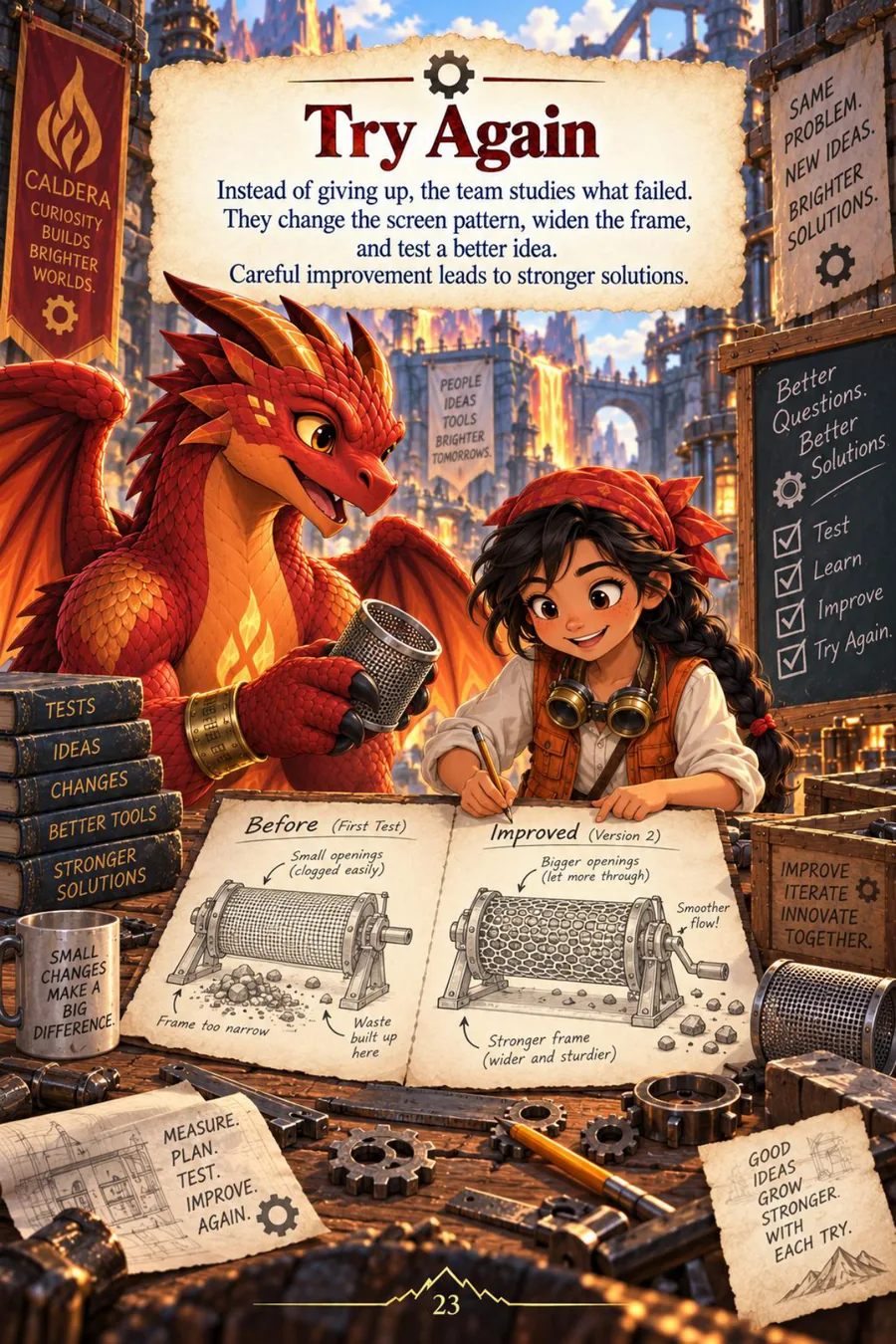
Instead of giving up, the team studies what failed.
They change the screen pattern, widen the frame, and test a better idea.
Careful improvement leads to stronger solutions.
Before (First Test): Small openings (clogged easily). Frame too narrow. Waste built up here.
Improved (Version 2): Bigger openings (let more through). Smoother flow! Stronger frame (wider and sturdier).
Better Questions. Better Solutions. Test. Learn. Improve. Try Again.
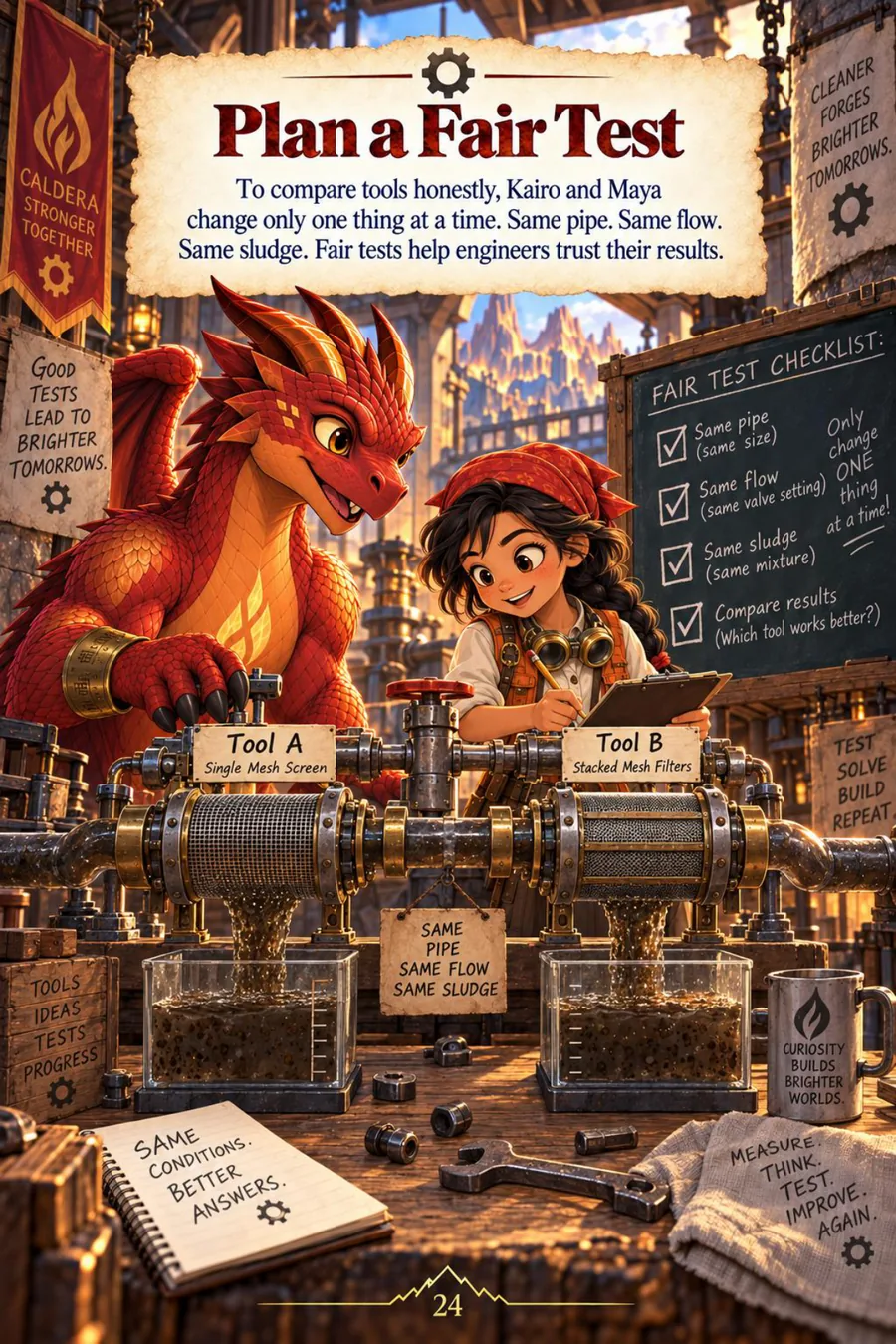
Read the words
To compare tools honestly, Kairo and Maya change only one thing at a time.
Same pipe. Same flow. Same sludge.
Fair tests help engineers trust their results.
Fair Test Checklist: Same pipe (same size). Same flow (same valve setting). Same sludge (same mixture). Compare results (which tool works better?). Only change ONE thing at a time!
Tool A: Single Mesh Screen. Tool B: Stacked Mesh Filters.
Same pipe. Same flow. Same sludge.
- Pick something to design, like a paper boat.
- Write 1 thing it must do: a criterion.
- Write 1 limit you must follow, like using only 1 sheet of paper.
You need: paper, a pencil.
Can you remember? A new backpack must hold books, and cost under 20 dollars. Which one is the limit?
Costing under 20 dollars. That is the constraint.
For grown-ups
Learning goal: I can sort criteria from constraints, plan a fair test, and pick the design that meets all the criteria.
Grade 3-5.
| Code | Standard |
|---|---|
| 3-5-ETS1-1 | Define a simple design problem reflecting a need or a want that includes specified criteria for success and constraints on materials, time, or cost. |
| 3-5-ETS1-3 | Plan and carry out fair tests in which variables are controlled and failure points are considered to identify aspects of a model or prototype that can be improved. |
| 3-5-ETS1-2 | Generate and compare multiple possible solutions to a problem based on how well each is likely to meet the criteria and constraints of the problem. |
Talk about it:
- Why must a fair test change only one variable at a time?
- What criteria would matter most for a filter you needed to build at home?
About 7 minutes.
How the game teaches it: evidence first, then the rider's hints (never the answer); no stars, scores or timers.
The full teacher guide is in the book.
Only the pages from this mission are shown here. From the Dragon STEM series by Adisak Sukul.